Should your smart lock work only when you are standing at the door, or should it let you control access from anywhere? At Altix.ae, many buyers in the UAE compare bluetooth vs wifi locks to decide what level of convenience and control makes sense for their homes and workplaces in Dubai and Abu Dhabi.
For most people, the decision is simpler than it seems and comes down to a few practical differences.
Wi-Fi Locks vs Bluetooth Locks: What You Really Need to Know
Before choosing a smart lock, it helps to understand how these two technologies work at a basic level.
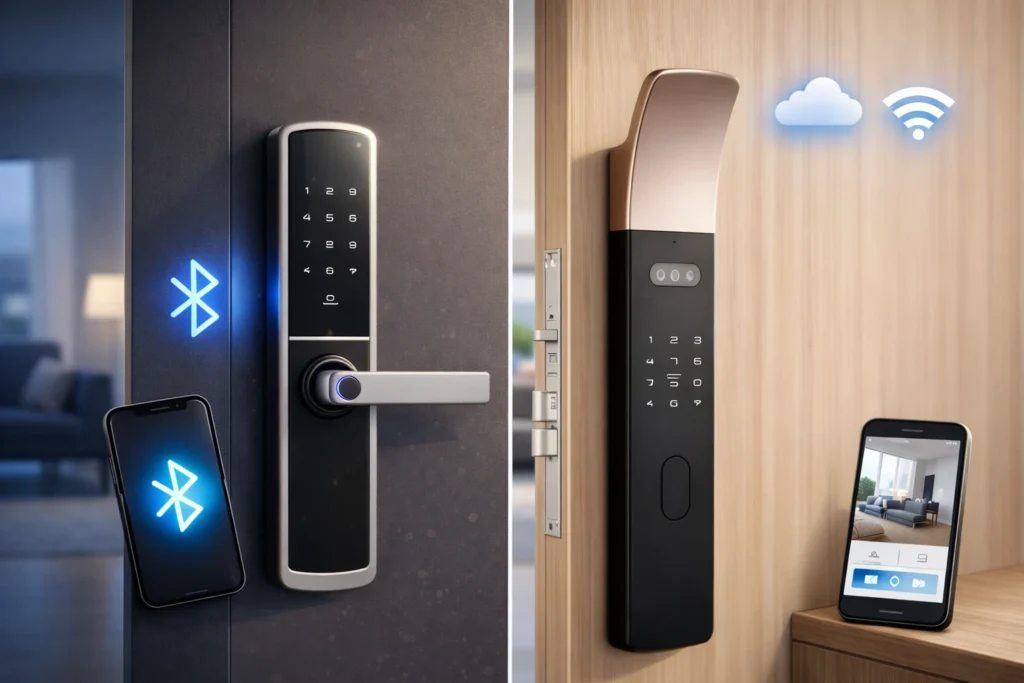
Bluetooth connects the lock directly to a nearby smartphone. Wi-Fi connects the lock to the internet, allowing it to be controlled remotely. Beyond that, buyers usually care about only three things.
The Three Differences That Matter Most
When choosing between Bluetooth and Wi-Fi smart locks, buyers do not need to compare every feature.
In most cases, the decision comes down to how access is managed, how often batteries need replacement, and whether smart home control is required.
Bluetooth vs Wi-Fi Smart Locks: Key Differences
| Factors | Bluetooth Smart Locks | Wi-Fi Smart Locks |
|---|---|---|
| Remote Access | Works only when the user is near the door. Remote access is possible only if a separate gateway is added. | Allows locking and unlocking from anywhere without additional hardware. |
| Battery Life | Uses low-energy communication and can last up to one and a half years on batteries. | Consumes more power and typically requires battery replacement after six to seven months. |
| Smart Home Integration | Requires a gateway to connect with Alexa or Google Home. | Connects directly with Alexa, Google Home, and other voice assistants. |
Bluetooth Smart Locks
Bluetooth smart locks are designed for simple, everyday access. They suit users who are usually present on site and do not need to manage access remotely.
Why people choose Bluetooth locks?
- Reliable operation without internet
- Longer battery life in UAE conditions
- Fast response when unlocking at the door
- Simple setup for residential use
Where Bluetooth locks work best?
- Apartments with single or family access
- Private villas with limited users
- Homes with unstable internet connections
- Properties with low access changes
Wi-Fi Smart Locks
Wi-Fi smart locks focus on control and visibility. They are commonly used in spaces where access needs to be managed even when no one is physically present.
Why people choose Wi-Fi locks?
- Remote locking and unlocking
- Access monitoring and activity records
- Better control for multiple users
- Suitable for shared or managed spaces
Where Wi-Fi locks work best?
- Offices and commercial spaces
- Coworking environments
- Managed villas and rental properties
- Properties requiring remote oversight
Choosing Based on Property Type
The better option depends on how access is used day to day.
- Number of users: More users require easier access management
- Remote access needs: Some properties benefit from off-site control
- Internet reliability: Wi-Fi locks depend on stable connectivity
- Maintenance expectations: Battery replacement frequency varies
For neutral guidance on smart access decisions in the UAE, Altix.ae helps buyers understand these trade-offs without pushing unnecessary features.
The Best of Both Approaches
Some properties use smart locks that rely on Bluetooth for daily access and add Wi-Fi through a gateway for remote control when needed. This approach balances battery life with flexibility and can suit mixed residential or commercial use when evaluating bluetooth vs wifi locks.
Smart Lock Connectivity Examples on Altix.ae: Wi-Fi and Bluetooth Models
FAQs
Both Bluetooth and Wi-Fi smart locks can be secure when installed correctly. Security depends more on access control practices and proper setup than on the connectivity type.
Bluetooth locks usually last longer on batteries, while Wi-Fi locks may require more frequent replacement due to higher power usage, especially in hot climates like Dubai and Abu Dhabi.
No. Bluetooth smart locks work without internet and only require a smartphone nearby to operate.
Yes. Many smart locks allow Wi-Fi access to be added later using a gateway, offering flexibility if remote access is needed in the future.