


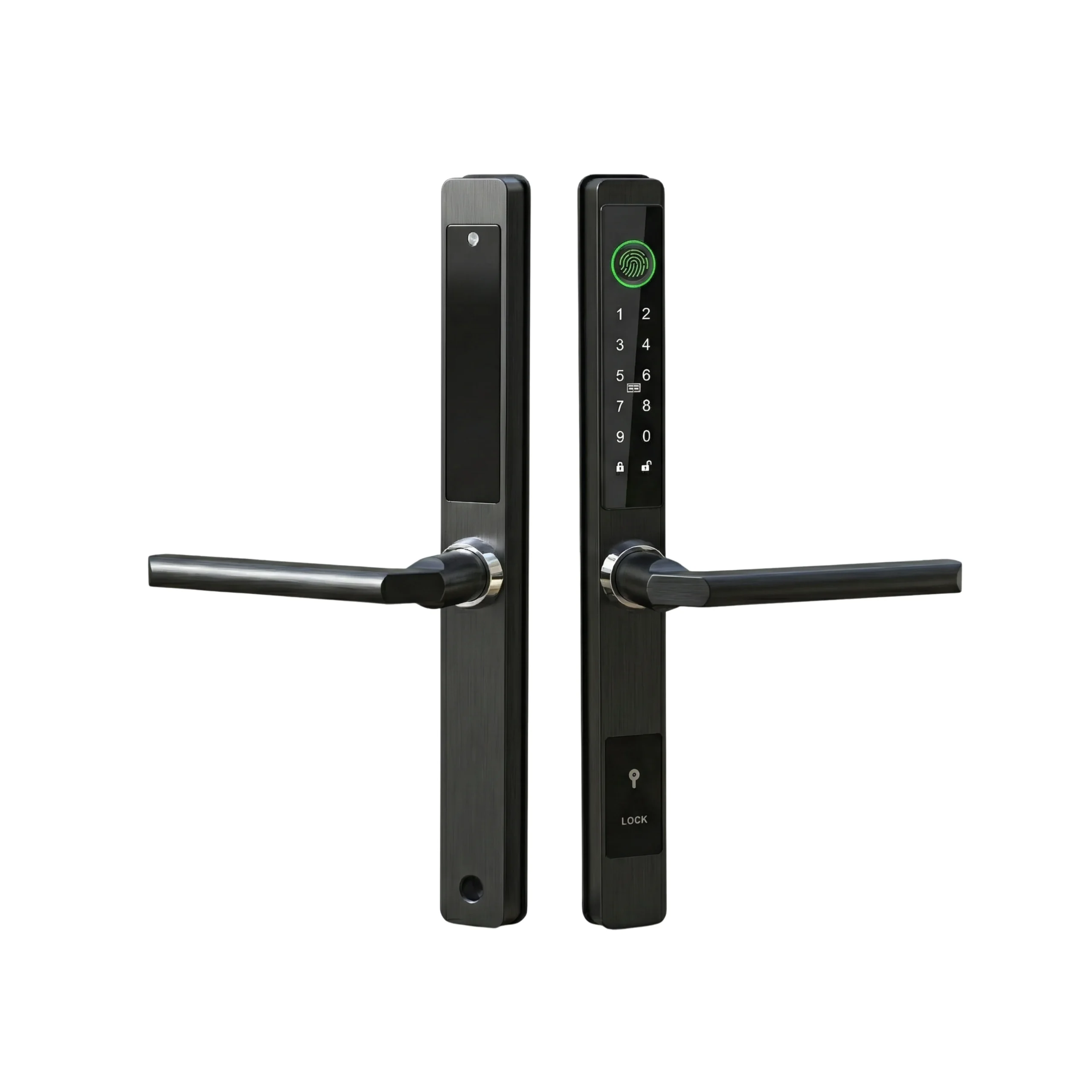

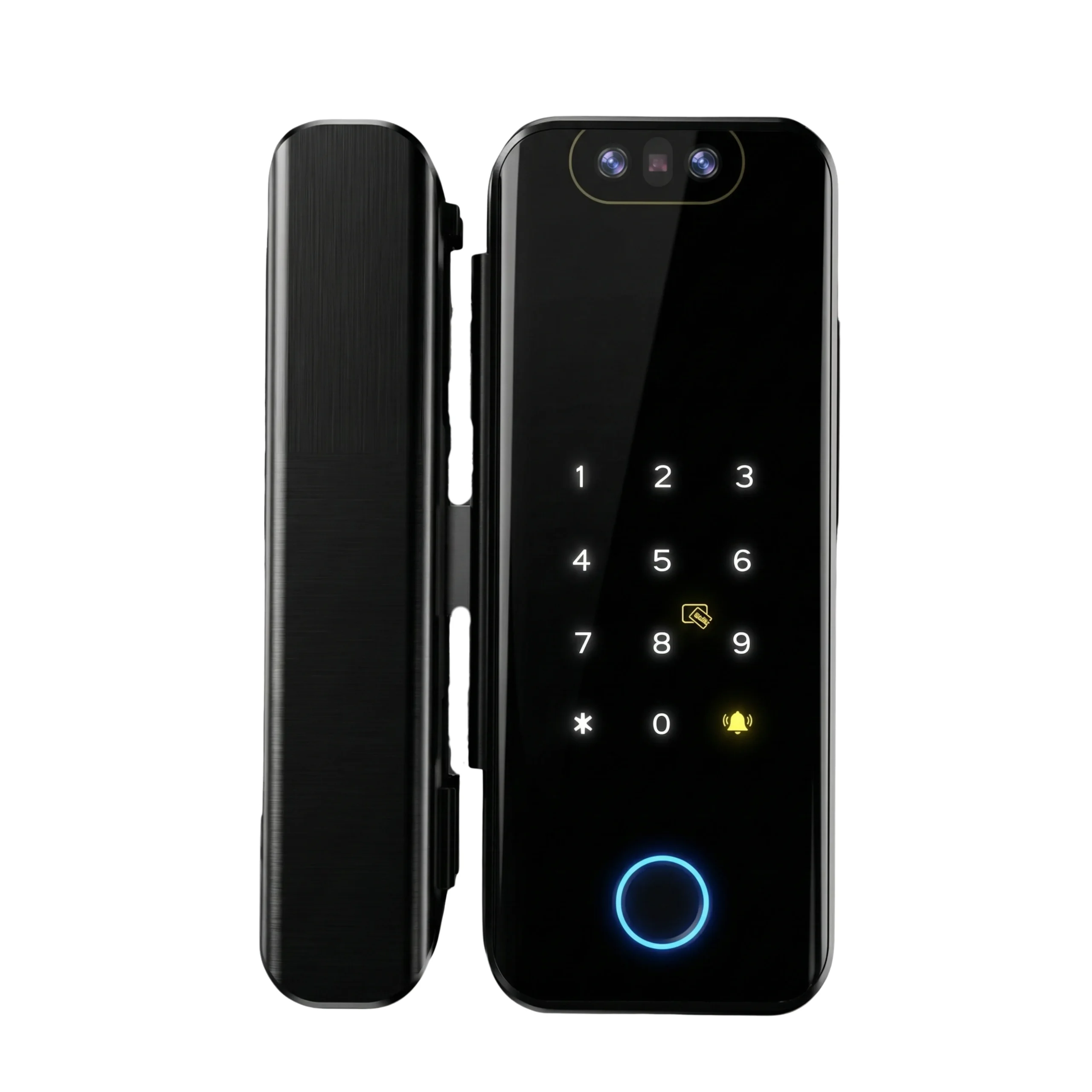
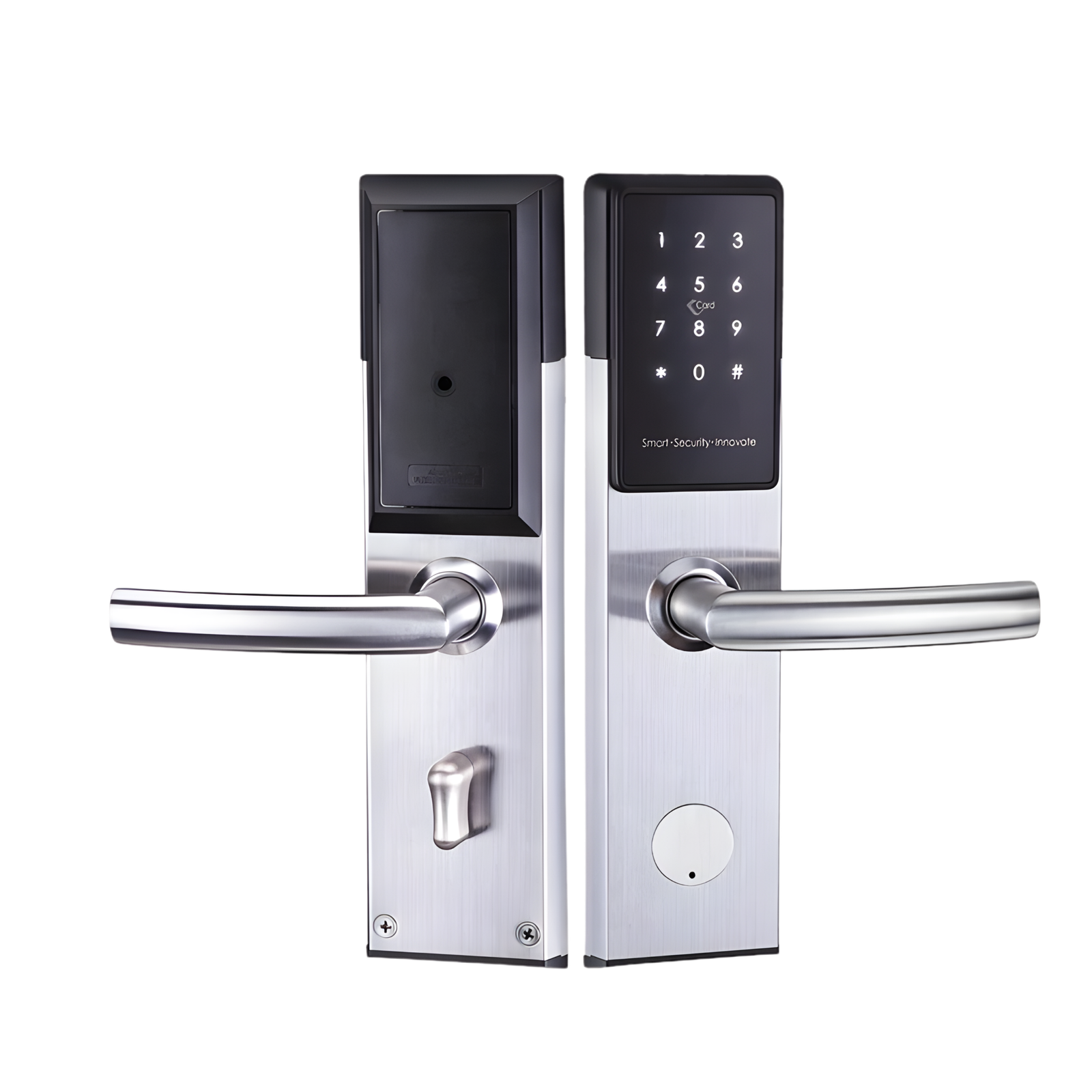
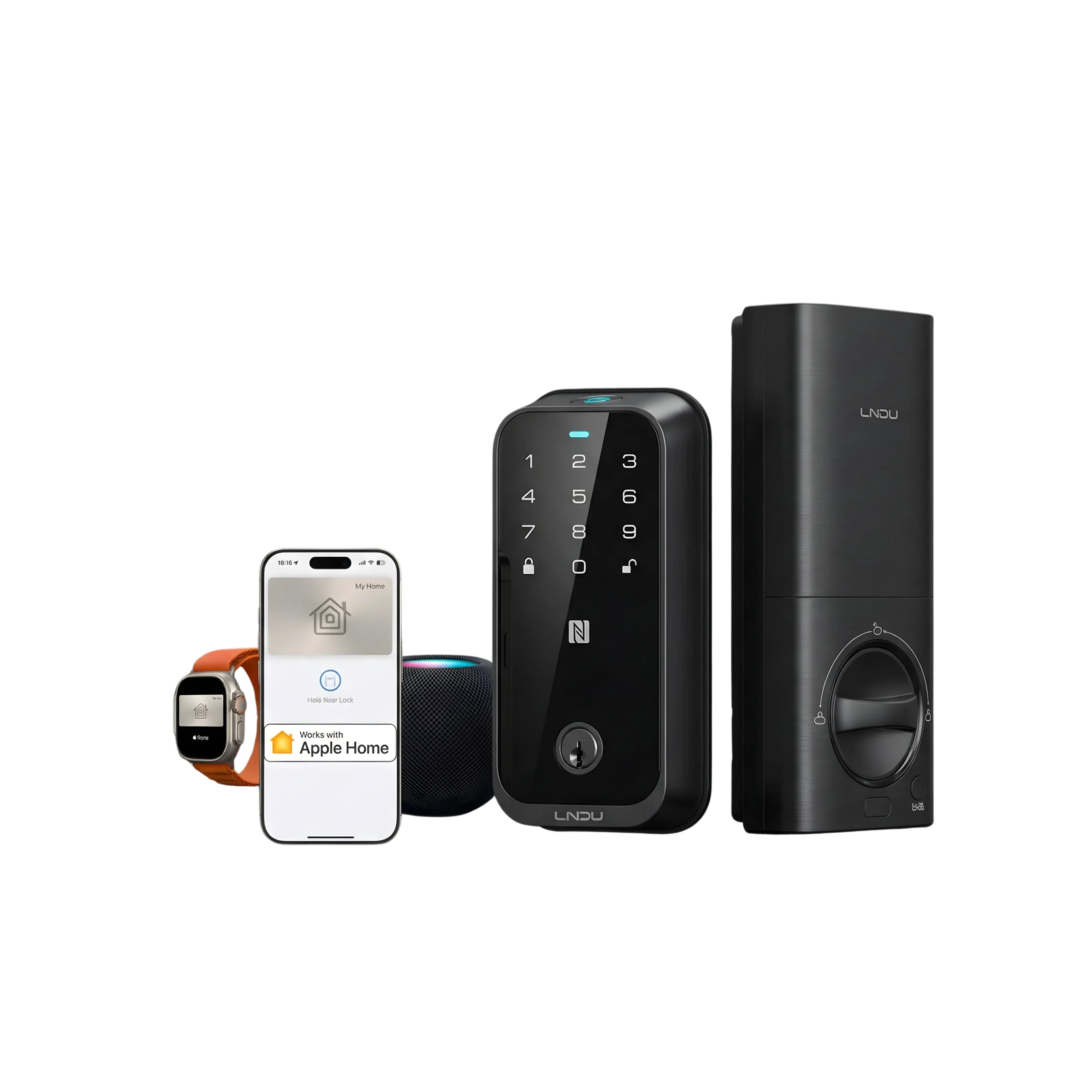
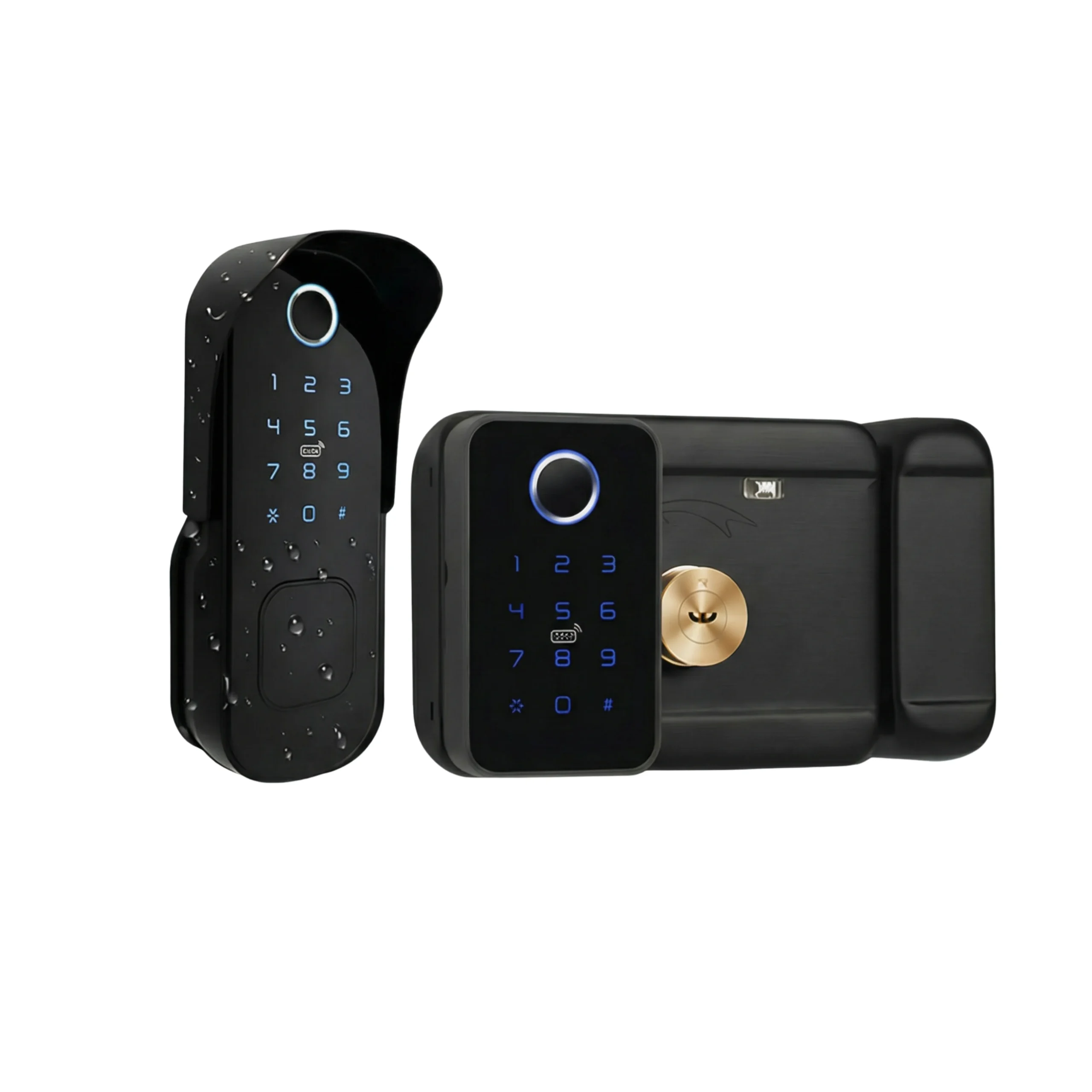
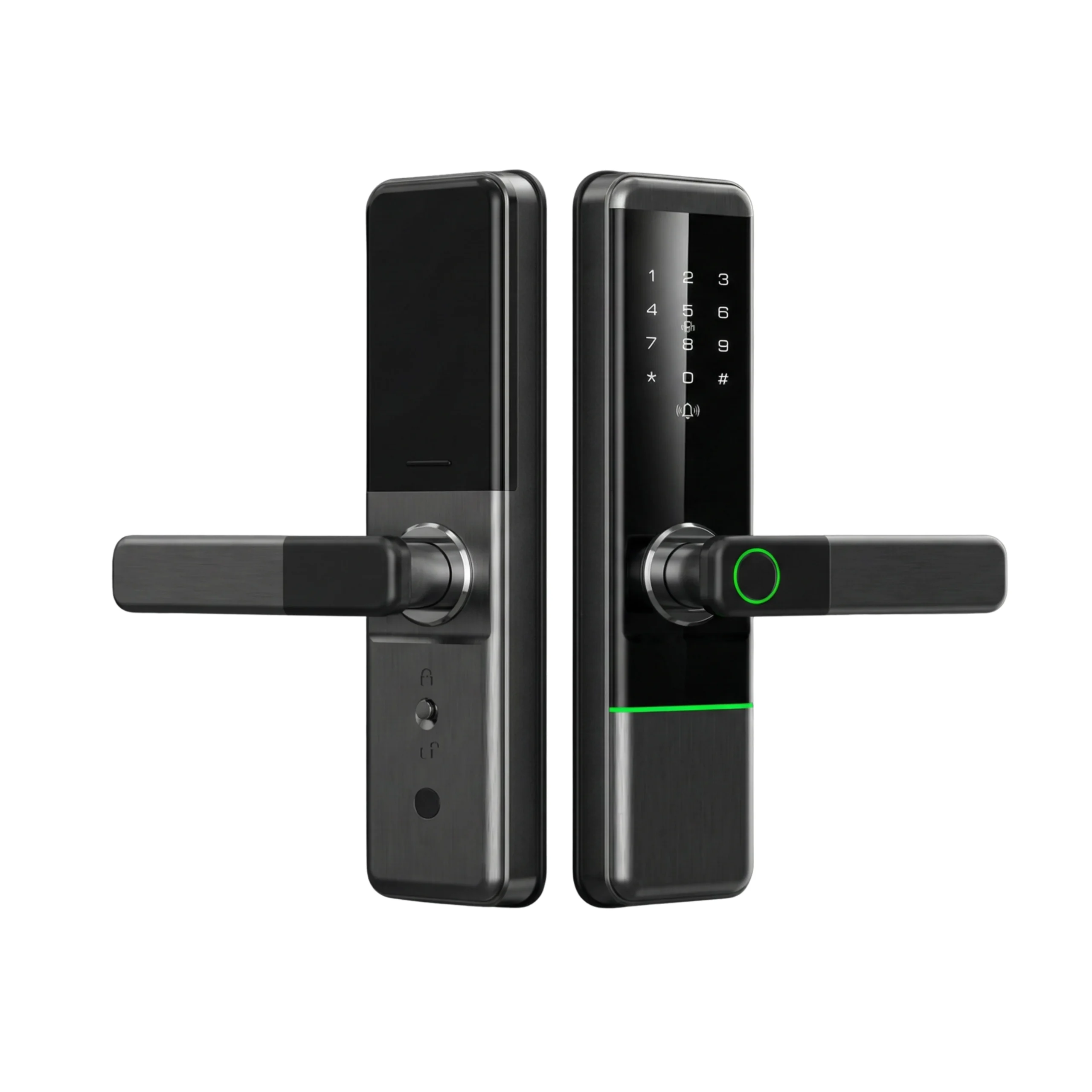









The smart lock goes on the active leaf, the one you open every day. The other leaf, the passive one, doesn’t get a lock at all. It gets bolted into the frame at the top and into the floor at the bottom, and the smart lock’s bolt throws into its edge.
That second part is the bit people miss. If the passive leaf isn’t bolted, a firm push where the two doors meet swings both leaves open together, and your new smart lock goes with them. The lock is only as good as the two flush bolts on the other door.
This post covers how to tell which leaf is which, what to check on the passive leaf before you buy, and what a fit on a typical villa double door looks like with us. If you haven’t measured your door yet, start with our measuring guide and come back.
What are the active and passive leaves on a double door?
A double door is two doors hung in one frame, meeting in the middle. In the trade each door is called a leaf.
The active leaf is the one you open daily. It carries the handle, the lock and usually the keyhole. The passive leaf (you’ll also hear inactive or fixed leaf) stays shut most of the time. You open it to get a sofa in, for a party, or when the movers come.
The two edges that meet in the middle are the meeting stiles. On most pairs there’s a strip along the passive leaf’s edge that covers the gap between them. That’s the astragal. It stops someone sliding a blade into the gap, keeps out dust and wind, and gives the active leaf something to close against.
On the edge of the passive leaf, near the top and near the bottom, you’ll find two small levers or slides set into the wood or metal. Those are the flush bolts. Slide them and a steel rod shoots up into the head of the frame and down into a hole in the floor or threshold.
Which leaf should get the smart lock?
Put it on the active leaf, every time. Look for the leaf that already has a keyhole and a handle that moves the latch, and check its edge for the lock body pocket. On unequal pairs that’s nearly always the wider leaf. On equal pairs it can be either side, so go by the pocket, not by which side looks right.
A smart lock on the passive leaf makes no sense. You’d have to unbolt that leaf every time you came home.
Some people ask about putting a smart lock on both leaves. On a residential double door there’s no reason to. You’d pay twice, manage two sets of batteries and codes, and the meeting stiles still need to be held by bolts. One smart lock on the active leaf plus two solid flush bolts on the passive leaf is the correct setup.
Why does the passive leaf need bolts top and bottom?
On a single door, the lock’s bolt goes into a steel strike fixed to the wall frame. The frame doesn’t move.
On a double door, the bolt goes into the edge of the passive leaf. That leaf is hung on hinges, the same as the active one. The only thing stopping it from swinging is its flush bolts. So the chain is:
- Smart lock bolt holds the active leaf to the passive leaf.
- Flush bolts hold the passive leaf to the frame and the floor.
- Frame and floor hold everything to the house.
Break link 2 and links 1 and 3 don’t matter. Both leaves swing open as a pair, still locked to each other.
That’s why we check flush bolts before we quote any double door. An AED 2,000 lock against a passive leaf held by one worn top bolt is doing very little.
One bolt isn’t enough either. With only the top bolt in, the bottom of the passive leaf can be pushed in a few centimetres, and on a tall villa door that’s often enough gap to work at the active leaf’s bolt. With only the bottom bolt in, the top flexes, so you need both thrown every time the door is locked.
What double door setups do we see on UAE villas?
| Door setup | Where we see it | Passive leaf held by | Smart lock route | What to check first |
|---|---|---|---|---|
| Equal timber pair, manual flush bolts | Older villas in Jumeirah, Mirdif, Al Barsha | Two manual flush bolts | Full smart lock with mortise body on active leaf | Flush bolts engage fully, door thickness, carved panels |
| Unequal pair (one wide leaf, one narrow side leaf, sometimes called a leaf-and-a-half) | Newer communities like Dubai Hills, Arabian Ranches 3, Tilal Al Ghaf | Two flush bolts on the narrow leaf | Full smart lock on the wide leaf | Width of the meeting stile on the active leaf |
| Steel or composite “security” pair with multipoint lock | Some villa main doors, Abu Dhabi and Al Ain villas | Rods from the active leaf’s multipoint into head and floor, plus flush bolts | Don’t replace the multipoint with a single-point lock. Send us photos | Whether lifting the handle throws rods top and bottom |
| Aluminium and glass pair | Patio, garden and pool doors | Surface bolts or flush bolts in narrow aluminium stiles | Narrow-stile lock or smart cylinder | Backset, often 25 to 35 mm. See our aluminium guide |
| Fire-rated pair | Communal corridors, villa garages connected to the house, compounds | Automatic flush bolts, plus a door coordinator | Approved hardware only. Ask the building or doorset supplier first | Fire label on the door edge or hinge side |
Most villa main doors in Dubai are the first two rows. Those are the ones a standard smart lock with a mortise body suits well.
How do you check the passive leaf before buying?
This takes five minutes. Do it with the active leaf open.
- Find both flush bolts, one near the top of the passive leaf’s edge and one near the bottom. On tall villa doors the top one is above head height, so stand on something stable.
- Throw both. Each rod should slide fully home with a firm push. If you have to hammer it, or it stops short, the passive leaf has dropped or the hole has filled with sand.
- Check the floor hole. Villa thresholds collect sand and grit, especially on doors facing the garden or a sandy street. A blocked floor keep means the bottom bolt only goes in a few millimetres. Clean it out with a thin screwdriver and a vacuum.
- Push the passive leaf. With both bolts thrown, push hard on the meeting stile from inside. It should barely move. If it rocks more than a few millimetres, the bolts or their keeps are worn.
- Close the active leaf and look at the gap between the two meeting stiles. It should be even from top to bottom. Wide at the top and tight at the bottom means one of the leaves has sagged on its hinges.
- Open the active leaf and look at the edge of the passive leaf at handle height. You should see a metal strike plate with holes for the latch and the deadbolt. Note how deep the deadbolt hole goes.
Take a photo of each step and you’ve got everything we’d look for on a site visit.
What makes a double door harder to fit than a single door?
The biggest difference is that the strike sits on a leaf that can move. The smart lock’s motorised deadbolt has to land in a hole in the passive leaf, and if that leaf sits a few millimetres out because a flush bolt isn’t fully home, the deadbolt hits the edge of the strike. With a mechanical lock you’d force it with the key. A motor stalls, retries, drains the batteries and shows an error. Most “my smart lock won’t lock” calls we get from villas with double doors turn out to be this.
The pocket in the passive leaf also has to be deep enough. Smart lock deadbolts often throw further than the old lock’s bolt, and if the hole is too shallow the lock reports it can’t finish locking. That’s usually a few minutes with a chisel at fitting time, but it needs planning.
Then there’s the backset. On unequal pairs, and on some equal pairs, the active leaf’s meeting edge is narrower than a single door’s edge would be. Measure the backset from that meeting edge. Our measuring guide shows how.
Last, check where the astragal is fixed. If it’s on the outside face of the active leaf rather than the passive leaf, it can sit right where the smart lock’s front panel wants to go.
Does a smart lock on a double door need a different model?
Not usually. A mortise smart lock that fits your active leaf’s thickness and lock body works the same on a double door as on a single door. What changes is the strike side.
The two numbers to match are still the lock body (6068 or 5085 for most villa doors) and the door thickness. Villa main doors are often thicker than apartment doors. Carved solid timber doors around 50 to 70 mm are common, and some are thicker. Measure near the handle, not at the top.
The EZVIZ DL05 we stock comes in a 6068 version and a 5085 version, and both list a door thickness range of 30 to 110 mm. That range covers most villa main doors we see. The front panel is 360 mm tall and 67 mm wide, so you need that much flat face on the active leaf’s meeting edge. Carved doors are where this fails.
If your active leaf has a lift-to-lock multipoint with rods going up and down, hold off. That lock is what’s holding the active leaf top and bottom. A single-point smart lock in its place makes the door weaker. We’d look at photos before suggesting anything.
What does it cost to fit a smart lock on a villa double door?
| Item | Price with us | Notes |
|---|---|---|
| EZVIZ DL05 6068 or 5085 | AED 499 | Door thickness 30 to 110 mm, Wi-Fi and Bluetooth built in |
| Mortise smart lock fitting, Dubai and Sharjah | AED 450 | Standard fitting on the active leaf |
| Mortise smart lock fitting, Abu Dhabi and other emirates | AED 550 | Same work, different call-out |
| Deepening the strike on the passive leaf | Usually done at the same visit | We’ll tell you after seeing photos if it’s more than a quick job |
| Replacing worn or broken flush bolts | Quoted from photos | Depends on the bolt length and door material. We don’t publish a fixed price because doors vary too much |
Prices are our listed prices on the day of writing. Check the product page before you order.
The cheapest outcome is the one where the flush bolts are already sound. The most expensive is fitting a lock, then finding the passive leaf has dropped, then paying for a second visit to fix hinges and bolts. That’s why we ask for the passive leaf photos up front.
Worked example: a 4-bedroom villa in Al Furjan
Here’s how a typical double door job goes with us.
- Saturday, 10:00. The owner sends a WhatsApp photo of the main door. Equal timber pair, carved panels, old lever handle and keyhole on the right leaf.
- 10:10. We ask for six photos: both flush bolts, the floor keep, the strike on the passive leaf, the active leaf’s edge with a tape across it, and both faces of the active leaf around the handle.
- 10:40. Photos come back. Door thickness 55 mm. Backset 60 mm, centres 68 mm, so a 6068 body. Flat area around the handle is about 80 mm wide and 400 mm tall between carvings, so the DL05 6068 panel at 67 mm wide fits.
- 10:45. The bottom flush bolt only goes about 5 mm into the floor because the keep is full of sand. We ask the owner to clean it out before the visit.
- 10:50. We quote AED 499 for the DL05 6068 plus AED 450 for fitting, AED 949 in total, and say we’ll check the strike depth on the day.
- Tuesday, 14:00. Our technician arrives. After cleaning, the bottom bolt throws fully. He fits the lock body and panels on the active leaf in about an hour.
- 15:10. He tests the deadbolt. It throws but stops 3 mm short in the passive leaf’s strike, so he deepens the pocket with a chisel and refits the strike. That takes ten minutes.
- 15:20. Ten lock and unlock cycles with fingerprint, code and app. Then he unbolts the passive leaf, locks the smart lock, and shows the owner both leaves swinging open together.
- 15:30. The owner sets up family fingerprints, a time-limited code for the cleaner, and app notifications.
We never skip step 8. Ten seconds of watching a “locked” door swing open teaches the family more about flush bolts than anything we could write here.
What goes wrong with smart locks on double doors?
The most common one is a passive leaf left unbolted. The cleaner opens both leaves to bring in a rug, or you open both for guests at a dinner, and the bolts never go back in. The smart lock shows locked, the app shows locked, and the house is held shut by nothing. Make throwing the flush bolts part of closing up, the same as switching off the lights.
Next is the motor stalling on a misaligned strike, covered above. When this happens the passive leaf has moved, so the fix is the bolts or the hinges. A new lock would stall the same way.
Auto-lock can also catch you out. On a heavy villa door that doesn’t swing shut on its own, auto-lock may throw the bolt while the door is still a few centimetres open, and on a double door that bolt hits the face of the passive leaf. Set a longer auto-lock delay, or turn it off and lock by hand.
Sand is a villa problem. Floor keeps near the desert edge, in Al Furjan, Arabian Ranches and Dubai South, fill up after every windy day. Clean the bottom keep every couple of months.
Timber pairs also move with the seasons. A solid wood door that lined up in dry January can rub in humid August. If the lock starts stalling in summer, have the strike checked before you blame the lock.
When shouldn’t you buy yet?
Four situations where we’d tell you to hold off.
A broken, missing or sticking flush bolt comes first. Fix it before you spend anything on a lock, because a smart lock won’t make an unbolted passive leaf secure.
An active leaf with a multipoint lock and rods top and bottom shouldn’t be swapped for a single-point smart lock. Send us photos and we’ll tell you what we’d do.
Fire-rated doors, for example a door from an integrated garage into the house or a door in a shared compound building, only take approved hardware. Ask the building management or the doorset supplier first. Our NOC guide covers how building approval works with the big developers.
Renting the villa? Get the landlord’s okay in writing before anyone cuts the door. Our rented apartment post covers how to ask, and the same approach works for villas.
Buy the lock that fits your door
EZVIZ DL05 6068 Smart Fingerprint Lock with Wi-Fi & Bluetooth
- Fingerprint
- Passcode
- Card
- App
Free UAE delivery
EZVIZ DL05 5085 Smart Fingerprint Lock with Wi-Fi & Bluetooth
- Fingerprint
- Passcode
- Card
- App
Free UAE delivery
How can Altix help?
Send us photos of the active leaf’s edge, both faces around the handle, both flush bolts, the floor keep and the strike on the passive leaf on WhatsApp. We’ll tell you which lock fits, whether the passive leaf needs work, and what the whole job costs before you pay anything.
We fit across the UAE. Mortise fitting is AED 450 in Dubai and Sharjah and AED 550 in Abu Dhabi and the other emirates.
FAQ
Which side of a double door does a smart lock go on?
The active leaf, the one you open every day. It’s usually the one that already has the keyhole and the lock body in its edge.Do I need a smart lock on both doors of a double door?
No. One smart lock on the active leaf is enough, as long as the passive leaf is bolted into the frame at the top and into the floor at the bottom.What are flush bolts?
Bolts set into the edge of the passive leaf. When you slide them, a steel rod goes up into the frame head and another goes down into the floor. They hold the passive leaf still so the active leaf has something solid to lock against.Why won’t my smart lock lock fully on my double door?
Usually the passive leaf has moved. A flush bolt isn’t fully home, the floor keep is full of sand, or a hinge has dropped. The deadbolt then hits the edge of the strike instead of going into it.Can I put a smart lock on a double door with a multipoint lock?
Don’t replace a multipoint lock with a single-point smart lock. The multipoint rods are part of what holds the door. Send us photos so we can look at the options.What is an astragal?
The strip along the meeting edge of a double door that covers the gap between the two leaves. It blocks tools and wind and gives the active leaf a stop to close against.How much does it cost to fit a smart lock on a villa double door in Dubai?
With us, the EZVIZ DL05 is AED 499 and mortise fitting is AED 450 in Dubai and Sharjah. Extra work on worn flush bolts is quoted from photos.Do smart locks work on aluminium and glass double doors?
Some do. Aluminium pairs usually have narrow stiles with a 25 to 35 mm backset, so you need a narrow-stile lock or a smart cylinder. Our aluminium guide covers it.


