


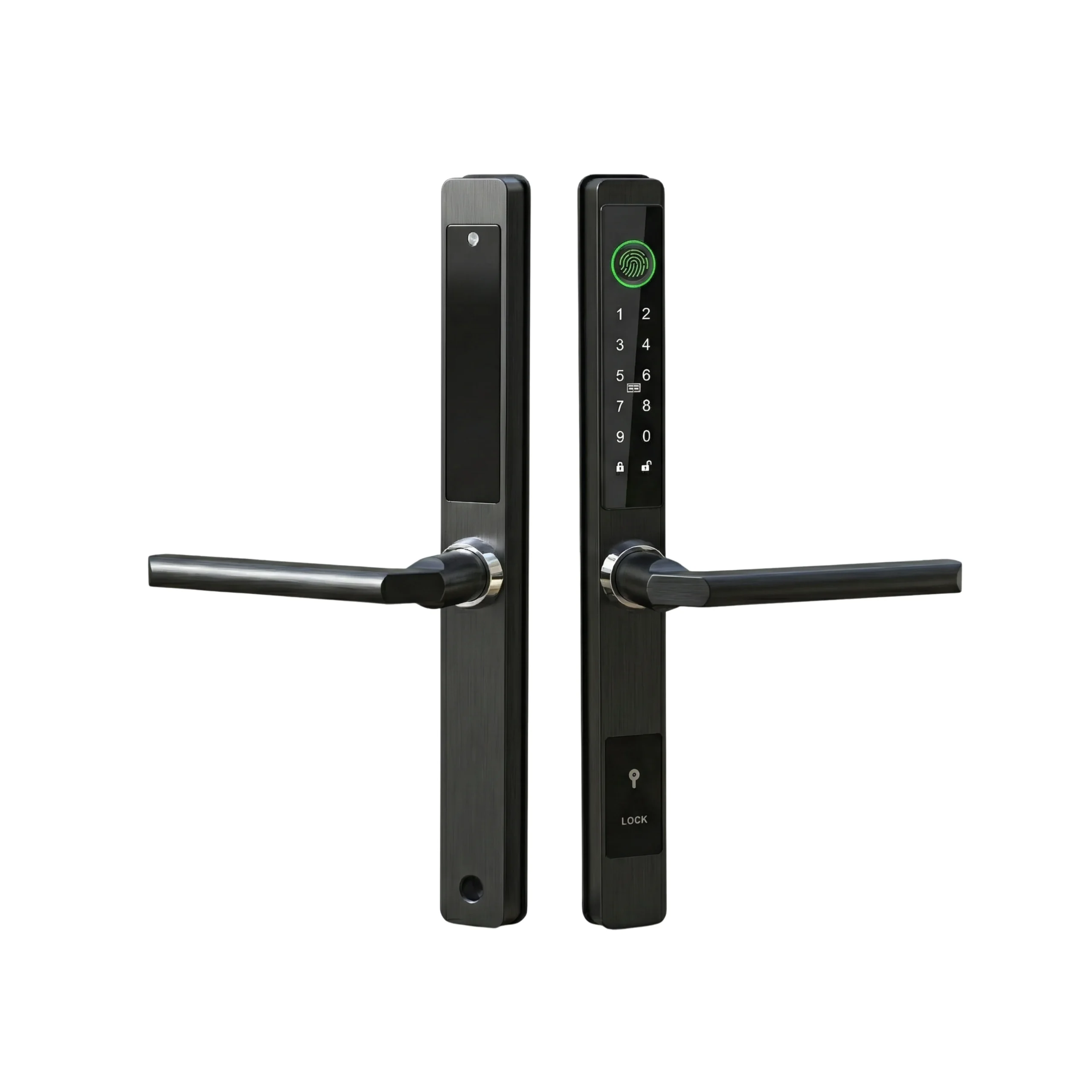

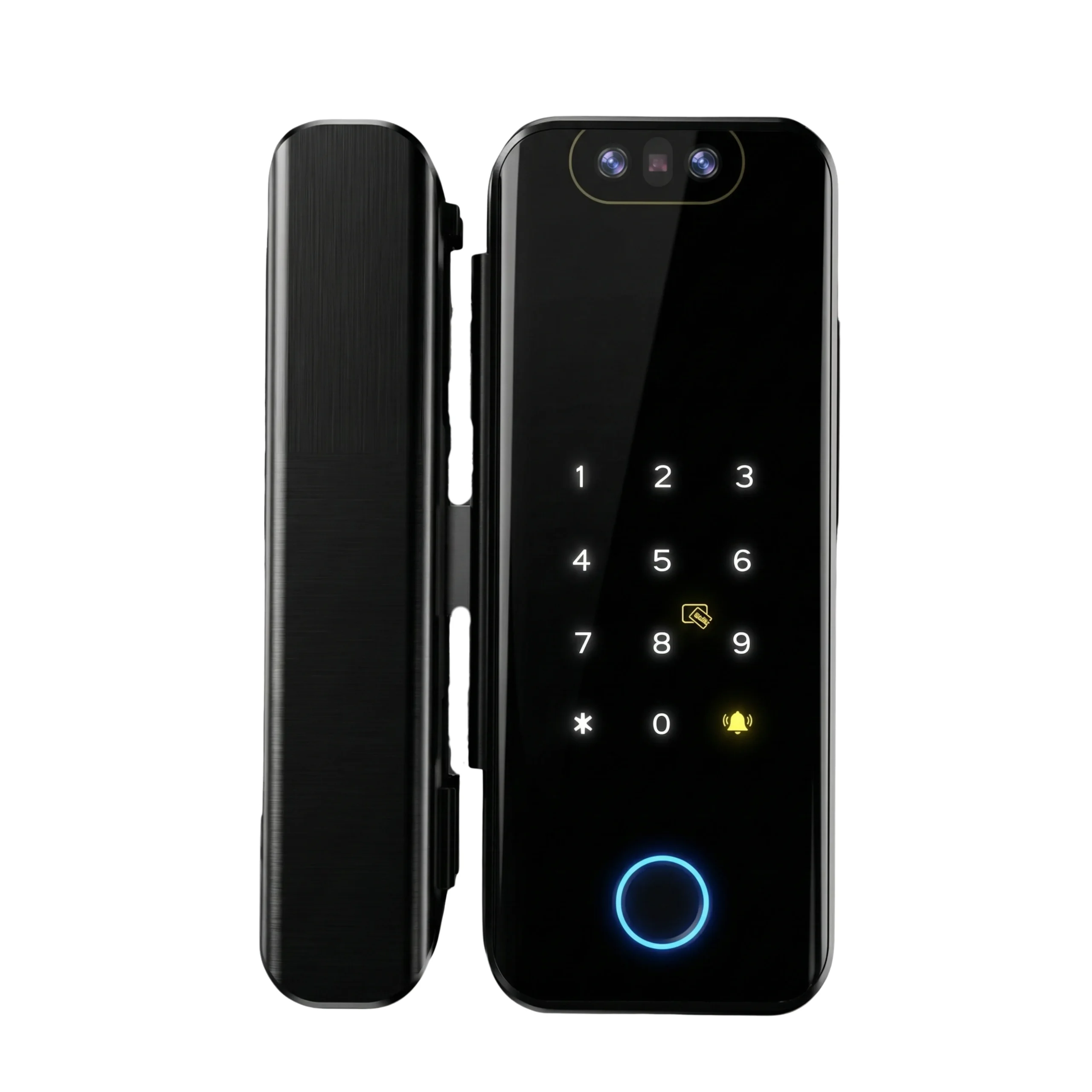
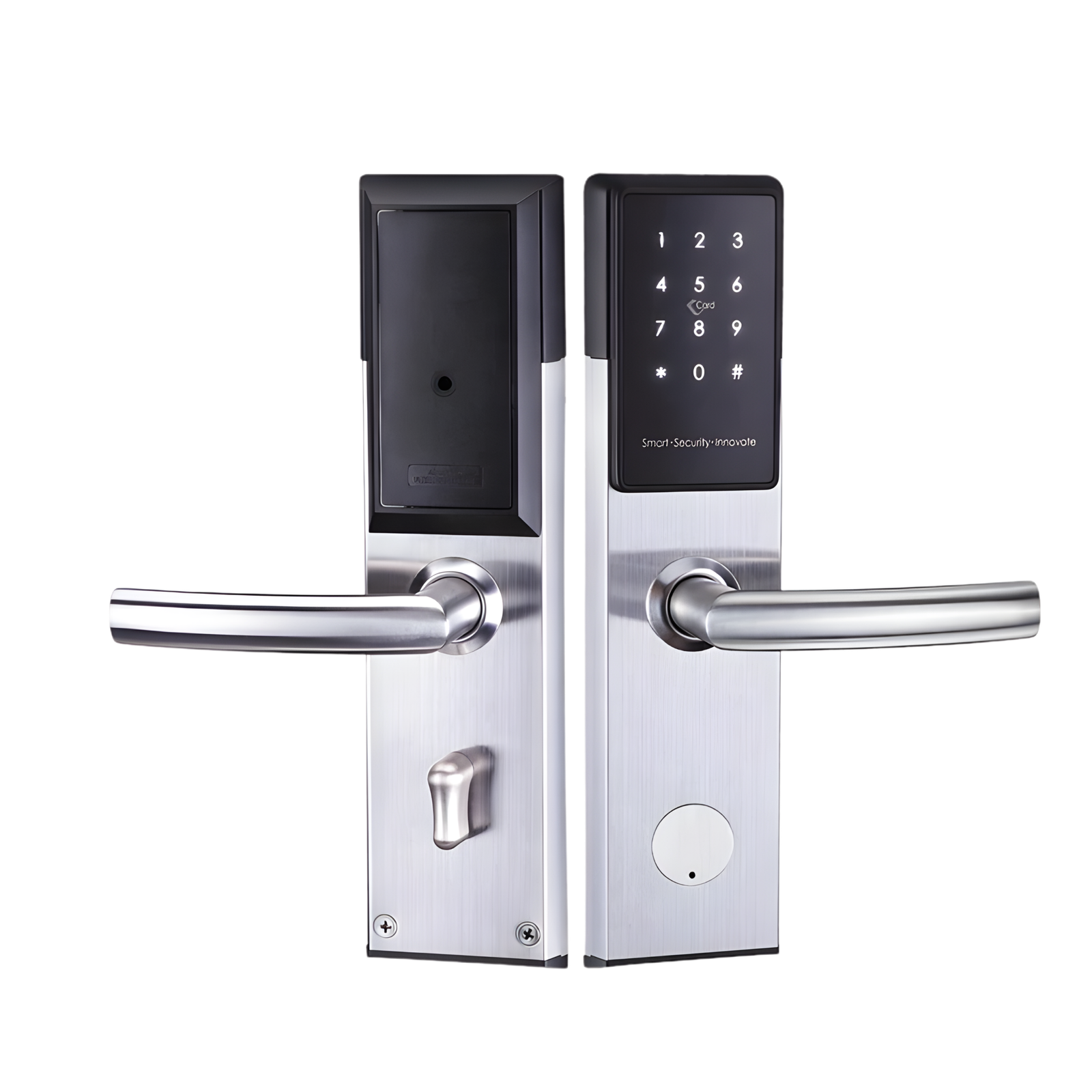
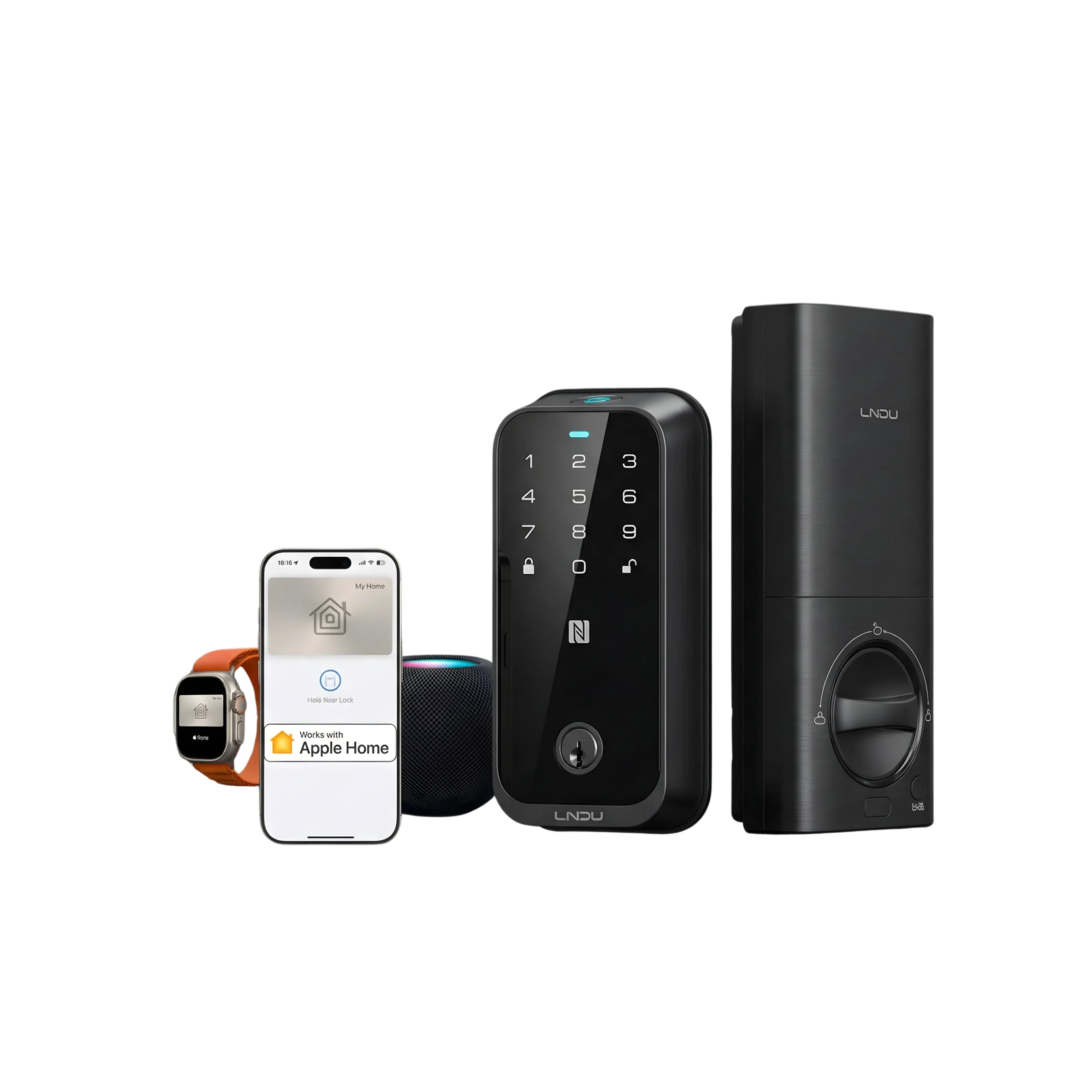









Yes, most steel villa doors in the UAE can take a smart lock. The door has to have a mortise pocket that fits a standard smart lock body, usually a 6068 or 5085, and it has to be single-point, not a multipoint lock with rods running up and down. If both are true, it’s a normal fit and takes about an hour.
If your steel door has a multipoint lock, or it’s fire-rated, stop there. Those are the two cases where a smart lock can make the door weaker or void its rating. You’ll find both below.
This post is about steel only. We mean the heavy “security door” sets you see on villas in Sharjah, Ajman and older parts of Abu Dhabi, plus the steel main doors on some newer Dubai villas. If your door is timber, our door measuring guide covers it. If you live by the sea, read our beachfront door material guide too, because salt changes the answer.
What kind of steel door do you have?
Steel doors on UAE villas fall into four groups, and each one gets a different answer. Open the door and look at the edge where the lock sits.
| Steel door type | Where we see it | What’s on the edge | Smart lock route |
|---|---|---|---|
| Hollow steel door, single-point mortise lock | Sharjah and Ajman villas, older Abu Dhabi villas, service doors | One faceplate with a latch and a deadbolt | Mortise smart lock, if the body is 6068 or 5085. The most common easy fit |
| Steel “security door” with multipoint lock | Imported security door sets, some Abu Dhabi and Al Ain villas | A long faceplate with hooks or bolts above and below the handle, or rods into the head and floor | Don’t swap for a single-point smart lock. Photos first |
| Steel door with a cylinder-only deadbolt | Some side doors and annex doors | A keyhole and a separate lever latch | Sometimes a retrofit lock over the cylinder works. Depends on the profile |
| Fire-rated steel door | Doors from an integrated garage into the house, plant rooms, compound buildings | A label on the edge or the hinge side | Approved hardware only. Ask the door supplier before anything else |
Most people reading this have the first type. It’s what local fabricators and the big imported brands supply as a standard villa main door.
How do steel doors differ from timber doors for a smart lock?
Steel doors aren’t solid steel. Most are two thin skins with a filling between them. Benchmarks from security door makers put the skins at around 0.8 mm on budget doors, 1.0 mm on security doors and 1.2 mm on high-security ones. The filling is honeycomb card, mineral wool, or foam, with a steel box welded in where the lock goes.
That box is the lock pocket. It’s welded in at the factory and you can’t make it bigger with a chisel the way you can with timber. The new lock body has to fit the pocket that’s already there, or the pocket has to be cut and rewelded, which is fabrication work, not a lock fit.
That’s the main difference from timber, where a slightly different lock body is ten minutes with a chisel. On steel, it’s a different job.
The other differences are smaller.
- Through-bolt holes have to be drilled through two steel skins. That takes the right drill bits and more time, but it’s routine.
- The skins are thin, so the fitter has to clamp the panels without denting the face.
- A dark steel door in full sun gets far hotter than a timber door.
Which numbers do you need to check on a steel door?
The same five numbers as any door, but two of them matter more.
| Number | How to measure | Why it matters on steel |
|---|---|---|
| Lock body (backset and centres) | Door edge to the centre of the handle spindle, then spindle to keyhole | The pocket is welded. The body has to match it exactly |
| Door thickness | Face to face across the edge, near the handle | Steel villa doors vary widely. Measure, don’t guess |
| Faceplate size | Height and width of the metal plate on the door edge | A longer faceplate often means a multipoint lock |
| Flat face around the handle | Height and width of the plain area on both sides | Decorative steel panels and studs can block the front panel |
| Gap to the frame | Gap between door edge and frame when closed | Steel frames sag less, but heavy doors drop on worn hinges |
Our measuring guide has the step-by-step version with photos of where the tape goes.
The two common bodies in the UAE are 6068 (60 mm backset, 68 mm centres) and 5085 (50 mm backset, 85 mm centres). On steel, if you’re not sure which you have, take the inside handle off and photograph the lock body faceplate. The numbers are often stamped on it.
Will the sun damage a smart lock on a steel door?
It can, if you pick the wrong lock or the door faces west.
A dark steel door in direct summer sun gets very hot. Door trade sources put dark metal door surfaces at roughly 60 to 70°C in full sun, with the sunny side far hotter than the shaded side. We haven’t found a measured study for UAE villas, so treat that as a rough guide. You can check your own door with a cheap infrared thermometer at 3 pm in July.
That heat affects the lock in three ways.
- Check the lock’s working temperature. The EZVIZ DL05 we stock lists -25 to 70°C. That’s fine for most doors, but a black steel door facing west with no porch can get close to the top of that range on the worst days. A light colour or a canopy changes this a lot.
- Fingerprint readers and touchscreens get very hot to touch. On a west-facing door in August, people stop using the fingerprint reader and use the app instead. Plan for that.
- Batteries don’t like heat. Alkaline AA cells drain faster in a hot outside panel. Most locks keep the batteries on the inside panel, which helps, but expect to change them more often than the box says.
There’s also thermal bow. When one side of a steel door gets much hotter than the other, the door bends slightly, by a few millimetres. A deadbolt that lined up in the morning can drag in the afternoon. A motorised bolt doesn’t force its way through like a key does. It stalls, retries and shows an error. If your door only plays up between 2 and 5 pm, this is usually why.
Does a steel door with a multipoint lock work with a smart lock?
Not with a standard mortise smart lock.
A multipoint lock throws bolts or hooks at two or three points down the door edge, and sometimes rods into the head and the floor. That’s a big part of why a steel security door is secure. A normal smart lock has one deadbolt in the middle. If you take the multipoint body out and put a single-point smart lock body in, you’ve removed most of what holds the door shut.
There are motorised multipoint locks made for metal doors. ISEO’s Multiblindo Smart is one. They replace the whole lock body, so it’s a hardware change that has to match your door maker’s pocket. We don’t stock them, and we’d only look at that route from photos of your door edge and the door’s make.
On some doors you can keep the multipoint and add a smart cylinder or a reader. Whether that works depends on the cylinder profile and the door maker. Send us photos. If we can’t do it, we’ll say so.
Can you fit a smart lock to a fire-rated steel door?
Only with hardware approved for that door.
A fire-rated door is tested and certified as a complete set, with the leaf, frame, hinges, closer and lock all part of the approval. Change the lock for one that isn’t part of that approval and the rating may not hold. That matters for the house, and it can matter for your insurance and for any inspection.
On villas, this is usually the door from an integrated garage into the house. In compound and labour accommodation buildings, it’s often the corridor doors. Look for a label on the door edge or the hinge side. If there’s one, ask the door supplier or the building’s facilities team which locks are approved before you buy anything.
What does it cost to fit a smart lock on a steel villa door?
| Item | Price with us | Notes |
|---|---|---|
| EZVIZ DL05 6068 | AED 499 | Door thickness 30 to 110 mm, 6068 body, Wi-Fi and Bluetooth, IP65 front panel |
| EZVIZ DL05 5085 | AED 499 | Same lock with a 5085 body |
| Mortise smart lock fitting, Dubai and Sharjah | AED 450 | Standard fitting into an existing matching pocket |
| Mortise smart lock fitting, Abu Dhabi and other emirates | AED 550 | Same work, different call-out |
| Cutting and rewelding a lock pocket | Not a lock fit | Needs a steel fabricator. We’ll tell you if your door needs it |
Prices are our listed prices on the day of writing. Check the product page before you order.
So a straightforward steel door in Sharjah costs AED 949 with the lock fitted. The expensive outcome is buying a lock, then finding the pocket doesn’t match. That’s why we ask for photos of the edge first.
Worked example: a steel main door on a Sharjah villa
Here’s how a steel door job usually goes with us.
- Sunday, 9:30. The owner of a villa in Al Rahmaniya sends a WhatsApp photo of the main door. Dark grey steel, west-facing, small porch roof, lever handle and keyhole.
- 9:40. We ask for five photos: the door edge with a tape across it, the faceplate close up, both faces around the handle, the hinge side, and the full door in daylight.
- 10:15. Photos come back. One faceplate, latch and deadbolt only, no hooks or rods. So it’s single-point. Backset 60 mm, centres 68 mm. Door thickness 60 mm. The flat area around the handle is about 90 mm wide, so the DL05’s 67 mm wide panel fits.
- 10:20. The owner mentions the old lock sometimes sticks in the afternoon. That sounds like thermal bow on a west-facing dark door. We note it for the visit.
- 10:25. We quote AED 499 for the DL05 6068 and AED 450 for fitting, AED 949 in total.
- Wednesday, 8:30. Our technician arrives early to fit before the door heats up. The old body comes out. The new body slides into the welded pocket with no cutting.
- 9:15. He drills the through-bolt holes through both skins and mounts the front and back panels.
- 9:40. Ten lock and unlock cycles with fingerprint, code and app. He then marks where the deadbolt meets the strike.
- 9:50. He opens the strike hole in the frame by about 2 mm towards the inside, so the bolt still has room when the door bows in the afternoon.
- 10:00. The owner sets up family fingerprints, a code for the driver and app notifications. We suggest leaving auto-lock on a 10 second delay, because a heavy steel door closes slowly.
What goes wrong with smart locks on steel doors?
The most common one is a lock body that doesn’t match the pocket. People buy a 6068 lock because it’s the most common, then find their door has a 5085 pocket, or a non-standard one from an imported set. On timber, a fitter can adjust. On steel, the lock goes back in the box.
Next is the afternoon stall. Thermal bow pulls the strike out of line by a few millimetres. The motor tries, fails and drains the batteries. The fix is the strike, not the lock.
Auto-lock catches out heavy doors too. A steel door closes slowly. If auto-lock fires before the door is fully home, the bolt hits the frame. Set a longer delay, or turn it off and lock by hand.
Dented skins are another. Over-tightening the through-bolts on a 0.8 mm skin pulls a dimple into the face. It’s cosmetic, but it’s permanent. A good fitter uses the right washers and stops when the panel is snug.
Rust shows up on older steel doors, especially near the coast in Ajman and Umm Al Quwain. Drilling new holes cuts through the paint. Each hole needs sealing, or it rusts from the inside and stains the face.
When shouldn’t you buy yet?
Hold off in four cases.
A multipoint lock on the door is the first one. Don’t swap it for a single-point smart lock. Send us photos first.
A fire-rated door is the second. Ask the door supplier which hardware is approved before you buy.
Third, a lock pocket that doesn’t match any standard body. You need a fabricator before you need a lock.
Last, if you’re renting the villa, get the landlord’s okay in writing before anyone drills a steel door. New holes in a steel skin can’t be filled invisibly. Our rented apartment post covers how to ask, and the same approach works for villas.
Buy the lock that fits your door
-
EZVIZ DL05 6068 Smart Fingerprint Lock with Wi-Fi & Bluetooth
- Fingerprint
- Passcode
- Card
- App
Free UAE delivery
EZVIZ DL05 5085 Smart Fingerprint Lock with Wi-Fi & Bluetooth
- Fingerprint
- Passcode
- Card
- App
Free UAE delivery
How can Altix help?
Send us photos of the door edge with a tape across it, the faceplate close up, both faces around the handle and the full door on WhatsApp. We’ll tell you if it’s single-point or multipoint, which body fits, and what the whole job costs before you pay anything.
We fit across the UAE. Mortise fitting is AED 450 in Dubai and Sharjah and AED 550 in Abu Dhabi and the other emirates.
FAQ
Can you put a smart lock on a steel door?
Yes, if the door has a single-point mortise lock and the pocket fits a standard smart lock body, usually 6068 or 5085. Most steel villa doors in Sharjah and Ajman are like this.
Do smart locks work on metal doors?
The lock doesn’t care what the door is made of. What matters is the lock body pocket, the door thickness and the flat space for the panels. Steel adds drilling work and sun heat to think about.
Can I replace a multipoint lock on a steel security door with a smart lock?
Not with a standard single-point smart lock. You’d remove the extra locking points that make the door secure. Send us photos so we can look at the options.
Will a smart lock work on a hot steel door in Dubai summer?
Check the lock’s working temperature. The EZVIZ DL05 lists up to 70°C. Dark, west-facing steel doors can get close to that in full sun, so a porch, a lighter colour or a different door face helps.
Why does my smart lock fail only in the afternoon?
On a steel door in the sun, the door bows slightly as one side heats up. The bolt drags on the strike and the motor stalls. Adjusting the strike usually fixes it.
Can you fit a smart lock on a fire-rated steel door?
Only hardware approved for that door. Ask the door supplier or the building’s facilities team first.
How long does fitting take on a steel door?
About an hour when the pocket matches, a little longer than timber because the through-bolt holes go through steel.
How much does it cost to fit a smart lock on a steel villa door in Sharjah?
With us, the EZVIZ DL05 is AED 499 and mortise fitting is AED 450 in Dubai and Sharjah, so AED 949 in total for a standard fit.
Popular Post
View All Security & Safety
Are Smart Locks Secure? Myths vs. Reality (Expert Breakdown)
Are smart locks secure for real homes and properties in Dubai and Abu Dhabi?For most households, rentals, and…
Read More Info → Apartments & Villas
How to control Smart Locks with Alexa, Google Home
Smart locks aren’t just about replacing keys, they’re about convenience. One of the biggest advantages of choosing the…
Read More Info → How-to
Tuya vs TTLock – Which App is best?
Tuya vs. TTLock: Which Smart Lock Platform Should You Choose for Your Home? Smart locks are becoming more…
Read More Info →
White Friday Smart Lock Deals in the UAE: How to Tell a Real Discount From a Fake One
Buying a smart lock on White Friday or National Day in the UAE? How to spot an inflated…
Read More Info →
Smart Locks in UAE: The 2026 Buyer’s Guide You Actually Need
If you’re upgrading security in your home, villa, or office in the UAE, the smartest move in 2026…
Read More Info →Wi-Fi, Remote & Smart HomeBluetooth vs Wi-Fi Locks – Which One Fits Your Space?
Should your smart lock work only when you are standing at the door, or should it let you…
Read More Info →


