











If your mum or dad lives alone, the front door’s job in an emergency is to let the paramedics in without anyone breaking it. A smart lock with a gateway lets you open the door from your phone, wherever you are, while you’re still on the line with 998. Add a named code for the building’s security desk, a card with a trusted neighbour, and a battery routine, and you’ve covered the cases that matter.
A lock won’t call for help or notice a fall. What it does is make sure the door doesn’t slow anyone down once help arrives. Here’s how we’d set it up for a parent in a Dubai apartment or a villa, what it costs, and where it goes wrong.
Why is the front door a problem in a medical emergency?
Picture the call. Your father has fallen in the bathroom of his flat in Al Barsha. He reaches his phone and calls you, or he presses the SOS on his watch. You call 998. When the crew gets there, they’re standing in a corridor in front of a locked door.
If nobody inside can walk to the door, someone has to open it from outside. In most families that means a spare key. And the spare key is usually in the wrong place: in your bag in Abu Dhabi, in a drawer in your house in Mirdif, or with a sibling in London.
The alternative is forcing the door. UAE apartment front doors are often solid timber or fire-rated, set in steel frames. They don’t give way quickly, and once they do you’re left with a broken frame, a broken lock and a flat you can’t secure that night. Who does the forcing, and when police get involved, is for the emergency services to decide. We’re not going to guess at their procedure. Our point is that a family can usually avoid getting to that stage.
What should the plan cover?
We set it up around four questions. If you can answer all four, the door won’t hold anyone up.
- Can someone open the door remotely, right now, from another emirate or another country?
- If the phone that controls the lock is dead or lost, who else can open it?
- How will you know something’s wrong if your parent can’t call?
- What stops the lock itself from failing, through flat batteries or an inside bolt?
Which ways of getting help through the door work best?
Here’s how the usual options compare.
| Option | Works if you’re abroad | Works if your phone is dead | You see who used it | Can you cancel it quickly | Main weakness |
|---|---|---|---|---|---|
| Spare key with a neighbour | Only if the neighbour’s home | Yes | No | No, you have to collect the key | Neighbour travels, moves out, or isn’t answering at 3am |
| Key with the building’s security desk | Yes, if the desk is staffed 24 hours | Yes | Only if the desk logs it | No | Many buildings won’t hold residents’ keys |
| Smart lock code for the security desk | Yes | Yes | Yes, in the lock’s log | Yes, delete it from the app | Desk staff change, so the code needs managing |
| RFID card with a trusted neighbour | Only if the neighbour’s home | Yes | Yes, if the card is named | Yes, delete the card | Same as a key, but you can cancel it |
| Remote unlock from the app (needs a gateway) | Yes | No, needs your phone | Yes | N/A | Needs Wi-Fi at your parent’s home and a working phone |
| Forcing the door | Yes | Yes | N/A | N/A | Delay, damage, and a door you can’t lock afterwards |
No single option covers everything. That’s why we always set up at least three: remote unlock for you, a code or card for someone nearby, and the mechanical key as the last fallback.
How does remote unlocking work, and what do you need?
Most battery smart locks talk Bluetooth only. Bluetooth reaches a few metres, so the lock can’t hear your phone from Business Bay if your mum’s in Sharjah. They’re built that way to save power, because holding a Wi-Fi connection all day would drain four AA batteries in weeks.
A gateway bridges the gap. It plugs into a socket near the front door, talks Bluetooth to the lock and Wi-Fi to the internet. Through the app, you can then unlock from anywhere and see entries as they happen.
For our Altix TTLock locks, that’s the Altix G2 gateway at AED 179.99. A few practical points:
- It needs 2.4GHz Wi-Fi. Most UAE home routers from du and e& broadcast 2.4GHz and 5GHz, so it’s usually just a matter of picking the right network.
- Plug it in close to the door with as few walls as possible between them. A socket in the entrance hall is ideal.
- If your parent doesn’t have home internet, you’ll need it for this. A basic home plan or a 4G/5G home router both work.
- If the power cuts out, the gateway goes offline, but the lock keeps working on its own batteries. You just lose remote control until the power’s back.
The Altix DB2 video doorbell (AED 234.99) is another route. Its product page says it has a built-in Bluetooth gateway and can pair with compatible Altix locks, so you can see who’s at the door, talk to them and unlock from one app. For this use, it lets you see the paramedics before you open the door. Pairing depends on the lock model, so check with us before buying the pair.
Who else should have a way in?
Your phone is a single point of failure. You might be on a flight, in a meeting with your phone in a locker, or in a dead spot in a car park. Someone physically nearby needs a way in that doesn’t depend on you.
In an apartment tower, the security desk is the obvious choice if it’s staffed around the clock. Give the desk its own permanent code, named “Security desk” in the app. Every time it’s used, the log shows it. Talk to the building manager first, since some buildings have rules about what staff can hold for residents. Change the code if the security company changes.
In a villa community, it’s usually a neighbour. Give them an RFID card rather than a code, because older neighbours often find a card easier than remembering six digits under stress. Our RFID cards are AED 34.99 for a pack of five. Name each card in the app (“Card: Fatima next door”) so you can delete one without touching the others.
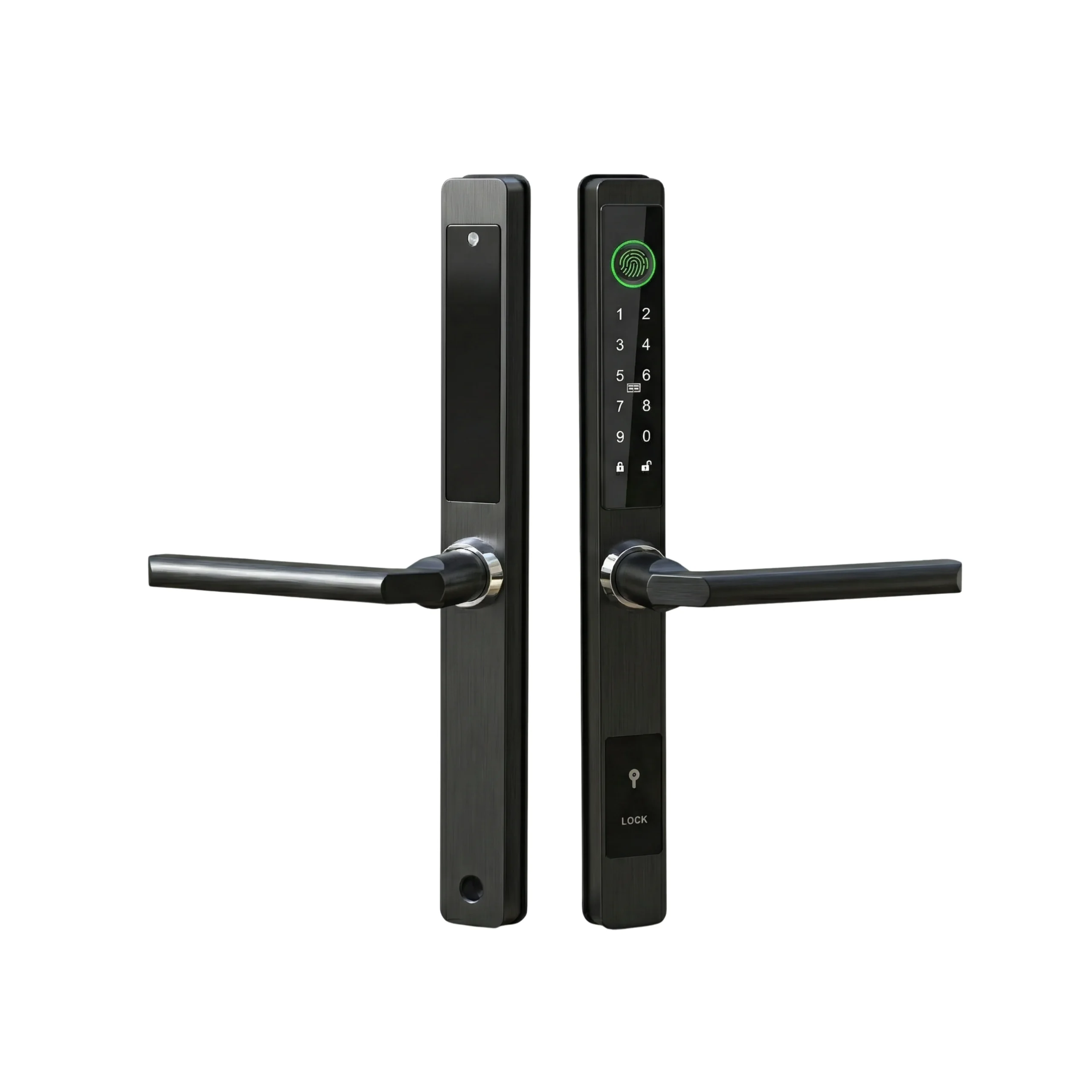
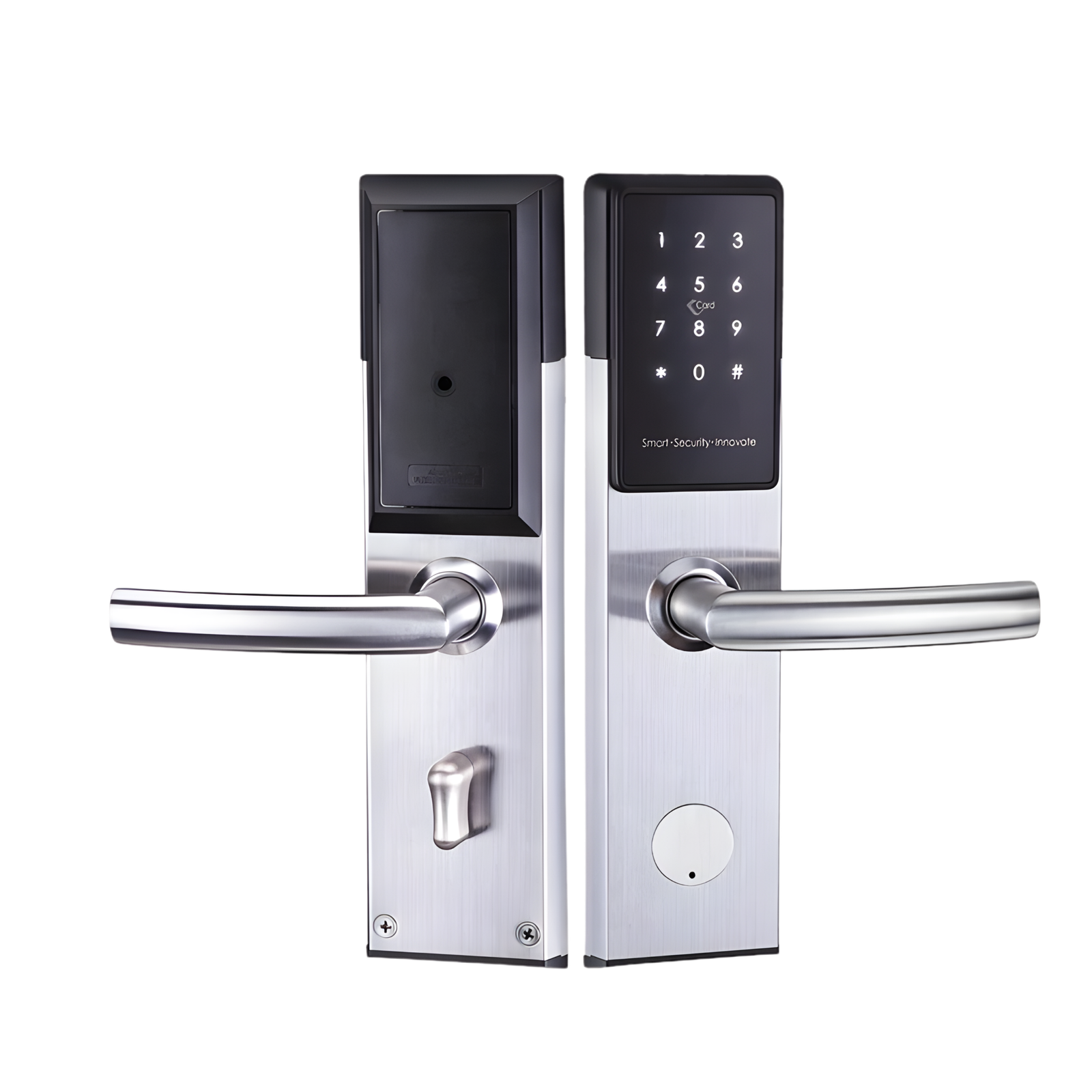
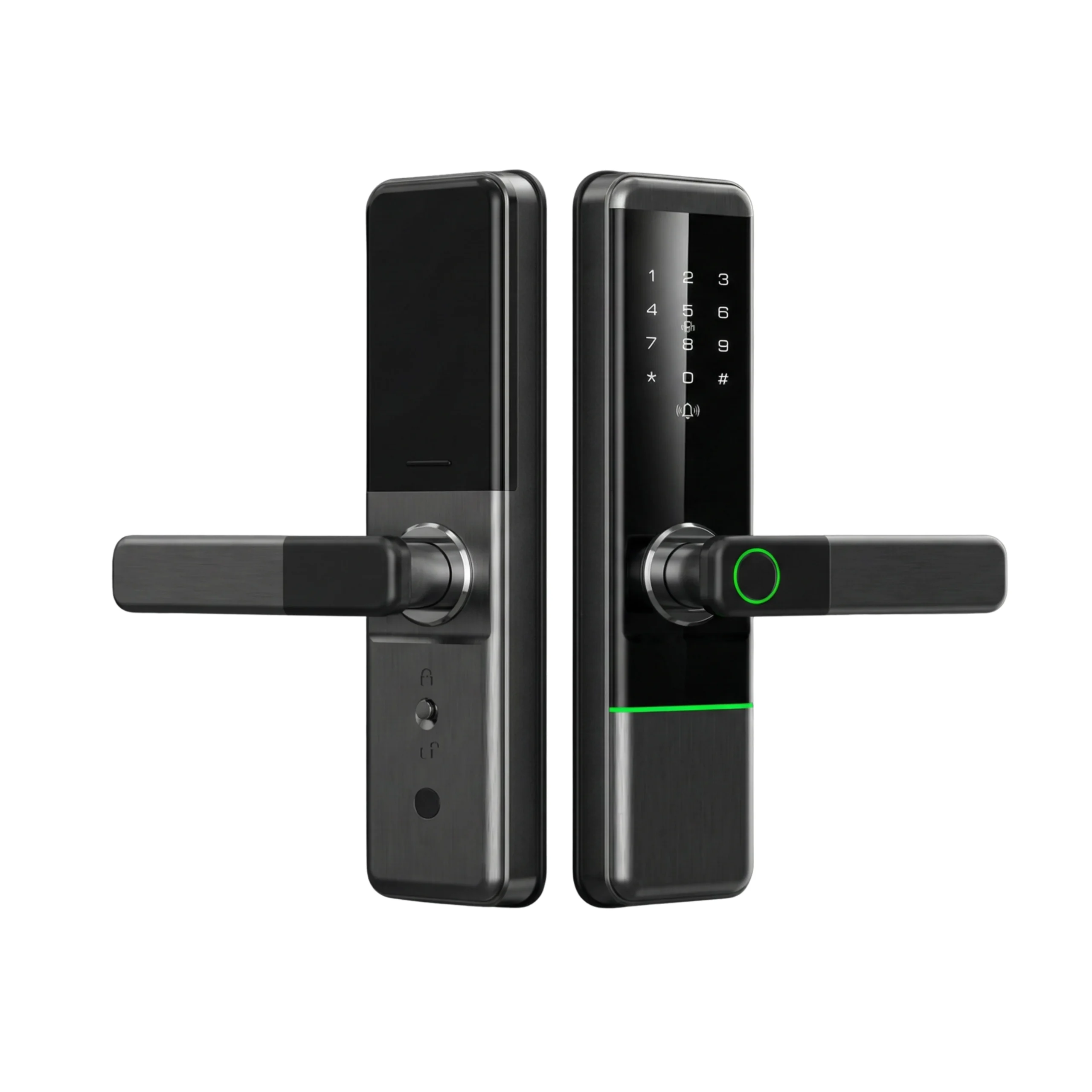
The Altix R9 (AED 494.99) supports IC cards along with fingerprint, code, app and a mechanical key. Card compatibility varies between lock brands, so if your parent has a different lock, check before ordering cards.
Keep the mechanical key too. Give one to whoever lives closest, and tell them it’s the last resort.
How do you know something’s wrong if your parent can’t call?
This is where people expect too much from a lock. A smart lock doesn’t detect falls, doesn’t know your parent’s heart rate, and won’t raise an alarm on its own. It knows one thing: when the door opened, and with which code, card or finger.
That one thing is still useful. With a gateway, the app shows entries as they happen. If your dad goes to the mosque for Fajr every morning, or your mum walks to the grocery by 10:00, you’ll see the door open. If it doesn’t open by the usual time, you call. If nobody answers, you call the neighbour or the security desk. If they can’t get a response at the door, you call 998.
There’s a limit, though. If your parent stays in all day, the log tells you nothing. That’s why the daily check is a habit on top of a phone call, not a replacement for one.
For the “call for help” part, look at a dedicated alarm. Dubai Police have run an SOS service with a wristband and app for people at risk, including the elderly, that sends an alert with location. The Community Development Authority’s Weleef home care programme offers alarm systems to UAE national seniors living alone in Dubai. Check current eligibility and availability with each of them directly. In Dubai, the DCAS SOS app also lets you request an ambulance and shares your location. Use one of these alongside the lock, since the alarm gets help on the way and the lock gets them through the door.
What can stop a smart lock from opening in an emergency?
These are the failures we see, roughly in order of how often.
The most common is an inside bolt or chain. Many apartment doors in older Dubai and Sharjah buildings have a separate deadbolt or a door chain on the inside. Lots of elderly parents lock it every night out of habit. If it’s on, no code, card, key or app will open the door from outside. Remove the chain, or agree that the separate bolt stays off. Most smart lock bodies include their own deadbolt anyway.
Flat batteries come next. The R9 runs on 4 AA batteries and warns you when they’re low. With a gateway, the app shows the battery level too. Don’t wait for the warning. Set a reminder and change them every six months, on two fixed dates a year, like 1 January and 1 July. Use good alkaline batteries, not the cheapest pack in the supermarket. Our post on battery life has more detail.
The gateway can also drop offline. A router reset, a new Wi-Fi password, or a power cut can knock it off. Check the gateway’s status in the app once a week. It takes five seconds.
Fingerprints can stop reading, since older skin is thinner and drier and the ridges wear. If your parent struggles with the reader, they may start propping the door or leaving it unlocked. Our post on fingerprints on worn hands covers what to do, including codes, cards and other biometrics.
The last one is people not knowing the plan. The neighbour has a card but doesn’t know when to use it, or the security desk has a code the night shift has never heard of. Put the plan on one page, with names, numbers and who holds what, and give a copy to everyone on it.
Worked example: a mother living alone in Discovery Gardens
Here’s how a typical setup with us runs, start to finish.
- Mrs. D, 76, lives alone in a one-bedroom apartment in Discovery Gardens. Her son lives in Abu Dhabi, her daughter in Toronto. The front door is a standard timber apartment door, 45mm thick. She has a separate bolt and a chain on the inside, and she uses both every night.
- Day 1, 20:00. The son sends us door photos on WhatsApp. We suggest the Altix R9 (AED 494.99), the G2 gateway (AED 179.99) and a pack of RFID cards (AED 34.99), plus fitting at AED 450 in Dubai. Total AED 1,159.97.
- Day 3, 10:00. Our technician fits the lock in about an hour. The old chain comes off. The son and his mother agree the separate bolt stays open, because the R9 has its own.
- 11:10. The gateway goes on a socket in the entrance hall and joins her 2.4GHz Wi-Fi. The son and daughter both get admin access in the app.
- 11:20. Mrs. D enrols two fingers on each hand and gets her own code, which she picks herself. She tests both three times.
- 11:30. The son walks to the security desk with the building manager. The desk gets its own code, named “Security desk”. One RFID card goes to the neighbour across the corridor, named “Card: Neighbour 304”. The spare mechanical key goes to the neighbour too, in a sealed envelope.
- 11:45. Notifications go on for both children. They agree on a check: she usually leaves for her walk by 09:30. If there’s no entry or exit by 11:00, the son calls her.
- Four months later, 11:05. No door activity. She doesn’t pick up. The son calls the neighbour, who knocks and gets no answer. The son calls 998, gives the address and says the door can be opened remotely.
- 11:25. The crew arrives. The security guard walks them up. The son unlocks the door from his desk in Abu Dhabi as the guard confirms they’re at the door. The log shows the unlock with his name.
- That evening. The son changes the security desk code as a precaution and reminds himself the batteries are due next month.
Nobody had to force the door, and the flat locked normally that night.
What does it cost?
These are our listed prices at the time of writing. Check the product pages before ordering.
| Item | Price | What it does in this plan |
|---|---|---|
| Altix R9 smart lock | AED 494.99 | Fingerprint, code, IC card, app and key entry, with access logs |
| Altix G2 gateway | AED 179.99 | Remote unlock and live entry alerts from anywhere |
| Altix RFID cards (5) | AED 34.99 | Cards for a neighbour or relative, each one cancellable |
| Altix DB2 video doorbell | AED 234.99 | See and talk to whoever’s at the door. Built-in Bluetooth gateway |
| Fitting with us | AED 450 Dubai and Sharjah, AED 550 Abu Dhabi and other emirates | Fitted, tested, family and codes set up |
A full setup with the R9, the gateway, cards and fitting in Dubai comes to AED 1,159.97. Add the doorbell and it’s AED 1,394.96. Home internet, if your parent doesn’t have it, is extra.
When isn’t a smart lock the right answer?
If your parent has dementia and may leave the flat confused, a lock that opens freely from the inside doesn’t solve that. You need advice from their doctor first, not a new lock.
If what you’re most worried about is a fall with nobody knowing, start with an alarm: a pendant, a watch with fall detection, or one of the SOS services above. Then add the lock.
Remote unlock won’t help either if your parent won’t stop using the inside chain. Talk it through with them before you spend anything.
Renting? Get the landlord’s written okay first. Our rented apartment guide covers how. If the front door is fire-rated (check for a label on the hinge edge), the building needs to approve the hardware. Our NOC guide explains the process with the main developers. Planning this across a whole building? Then our post on emergency access for buildings is the better starting point.
Buy the lock that fits your parent’s door
-
Altix DB2 Smart Video Doorbell WiFi Camera UAE | 1080p Full HD Video Two-Way Audio TTLOCK App (Black)
- App
- Wi-Fi
- Camera
Only 2 left
How can Altix help?
Send us photos of your parent’s door, the edge and both faces around the handle, on WhatsApp. Tell us where they live, who’s nearby and who’s abroad. We’ll tell you which lock fits, whether the gateway will reach, and set up the codes, cards and family access on the day we fit it.
We fit across the UAE. Fitting is AED 450 in Dubai and Sharjah and AED 550 in Abu Dhabi and the other emirates.
FAQ
Can I unlock my parent’s smart lock from another country?
Yes, if the lock has a gateway connected to Wi-Fi at their home. Without a gateway, a Bluetooth lock only works when your phone is within a few metres of the door.What happens if the power goes out at my parent’s home?
The lock keeps working on its own batteries. Codes, cards, fingerprints and the key still work. The gateway goes offline, so remote unlocking stops until the power is back.Will a smart lock alert me if my parent falls?
No. A lock only records when the door opens and who opened it. For falls, use a pendant, a watch with fall detection or an SOS service, and use the lock to let help in.Should I give the building’s security desk a code?
If the desk is staffed 24 hours and the building manager agrees, yes. Give it its own named code so every use shows in the log, and change it if the security company changes.Is an RFID card or a code better for a neighbour?
For an older neighbour, a card is usually easier because there’s nothing to remember. Name the card in the app so you can cancel it alone if needed.How often should I change the batteries?
Every six months, before the low-battery warning. Pick two fixed dates a year so it doesn’t get forgotten.What if my parent locks the inside chain or bolt?
Then nobody can open the door from outside, smart lock or not. Remove the chain or agree that the separate bolt stays open. Most smart lock bodies already include a deadbolt.How much does it cost to set this up in Dubai?
With us, the Altix R9, the G2 gateway, a pack of RFID cards and fitting come to AED 1,159.97 at current prices. Abu Dhabi and the northern emirates fitting is AED 550.Popular Post
View All Security & Safety
Are Smart Locks Secure? Myths vs. Reality (Expert Breakdown)
Are smart locks secure for real homes and properties in Dubai and Abu Dhabi?For most households, rentals, and…
Read More Info →
Elderly Parent Living Alone in the UAE: A Smart Lock Plan for Emergencies
If your parent lives alone in the UAE, a smart lock lets you open the door for paramedics…
Read More Info → Apartments & Villas
How to control Smart Locks with Alexa, Google Home
Smart locks aren’t just about replacing keys, they’re about convenience. One of the biggest advantages of choosing the…
Read More Info → How-to
Tuya vs TTLock – Which App is best?
Tuya vs. TTLock: Which Smart Lock Platform Should You Choose for Your Home? Smart locks are becoming more…
Read More Info →
Smart Locks in UAE: The 2026 Buyer’s Guide You Actually Need
If you’re upgrading security in your home, villa, or office in the UAE, the smartest move in 2026…
Read More Info →Wi-Fi, Remote & Smart HomeBluetooth vs Wi-Fi Locks – Which One Fits Your Space?
Should your smart lock work only when you are standing at the door, or should it let you…
Read More Info →


