












Battery anxiety is real, and it’s the reason most people hesitate over a smart lock in the first place. The worry isn’t that the lock is insecure. It’s that the battery dies while nobody’s home, or while you’re in another country, and a door you paid good money for turns into a problem. Manufacturers answer it with bigger packs and earlier warnings. The Lockin V7 Max answers it differently. It tops itself up continuously instead.
It’s AED 4,399 and it’s in stock with us. Whether it’s worth that depends almost entirely on which lock you’re comparing it to, and on whether your hallway can actually take the hardware it needs. That second part is the bit most coverage skips.
What is AuraCharge, and how does it work?
AuraCharge is Lockin’s optical charging system. A transmitter beams invisible infrared light at a receiver on the inside panel of the lock, and the lock converts that light back into electricity. The idea is that the battery never completes a full discharge cycle in normal use.
Be precise about the claim. This isn’t perpetual motion and it isn’t a solar panel. It’s a trickle input designed to offset a device that would otherwise slowly drain. The lock still has a battery and the battery still does the work. Lockin says the system works regardless of weather, ambient lighting or where it’s installed, and that the internal battery carries the lock for about a week if the charging is interrupted.
The beam carries eye-safe certifications from TÜV Rheinland and SGS. We’re repeating the manufacturer’s certification, not testing it ourselves.
One honest caveat before you get excited. The biometrics here are proven technology, because Lockin has been building vein locks since 2014. The optical charging is not. It was shown at CES 2026 and no independent reviewer we can find has lived with it through a year of real furniture, real people and real doors. We haven’t either. Treat the charging as promising rather than proven.
What does AuraCharge need in your home?
This is the part that decides whether you can have this lock at all, and it rarely makes the headlines.
The transmitter is a separate box. It plugs into a mains socket inside your home, sits on a table or mounts on a wall, and needs an unobstructed line of sight to the inside panel of the lock from up to 4 metres, about 13 feet.
So the wireless lock comes with a wired appliance in your entrance hall. You’re not removing a power problem, you’re moving it off the door and onto your wall, where it’s easier to solve but still visible and still drawing mains power around the clock.
The check to do before you order
Five minutes with a tape measure will tell you whether this lock is possible in your home.
- Stand inside your front door and find the nearest mains socket. Measure the straight-line distance to the inside face of the door. If it’s over 4 metres, stop here.
- Crouch or stand at the height the inside panel will sit, roughly handle height, and look from the socket to the door. You need to see the door face with nothing in the way.
- Check what’s going to live in that path. Shoe cabinets, a console table, a coat rack, a tall plant. Anything at panel height blocks the beam.
- Watch the path for a day. If it’s where people stand to take their shoes off, it’ll be interrupted daily, and daily interruptions on a week of reserve is a different proposition to a clear run.
- Check the socket isn’t one you need for something else. This transmitter is a permanent occupant.
- Send us a photo of the hallway and the door on WhatsApp and we’ll tell you whether it works before you spend AED 4,399.
In a lot of Dubai apartments the nearest socket is around a corner in the living room, or sits exactly where the shoe cabinet goes. That’s not a fault in the lock. It’s a fault in the match between the lock and the flat, and it’s cheaper to find out now.
Why does this lock need it more than most?
Here’s the argument that matters, and it’s not the one the marketing makes.
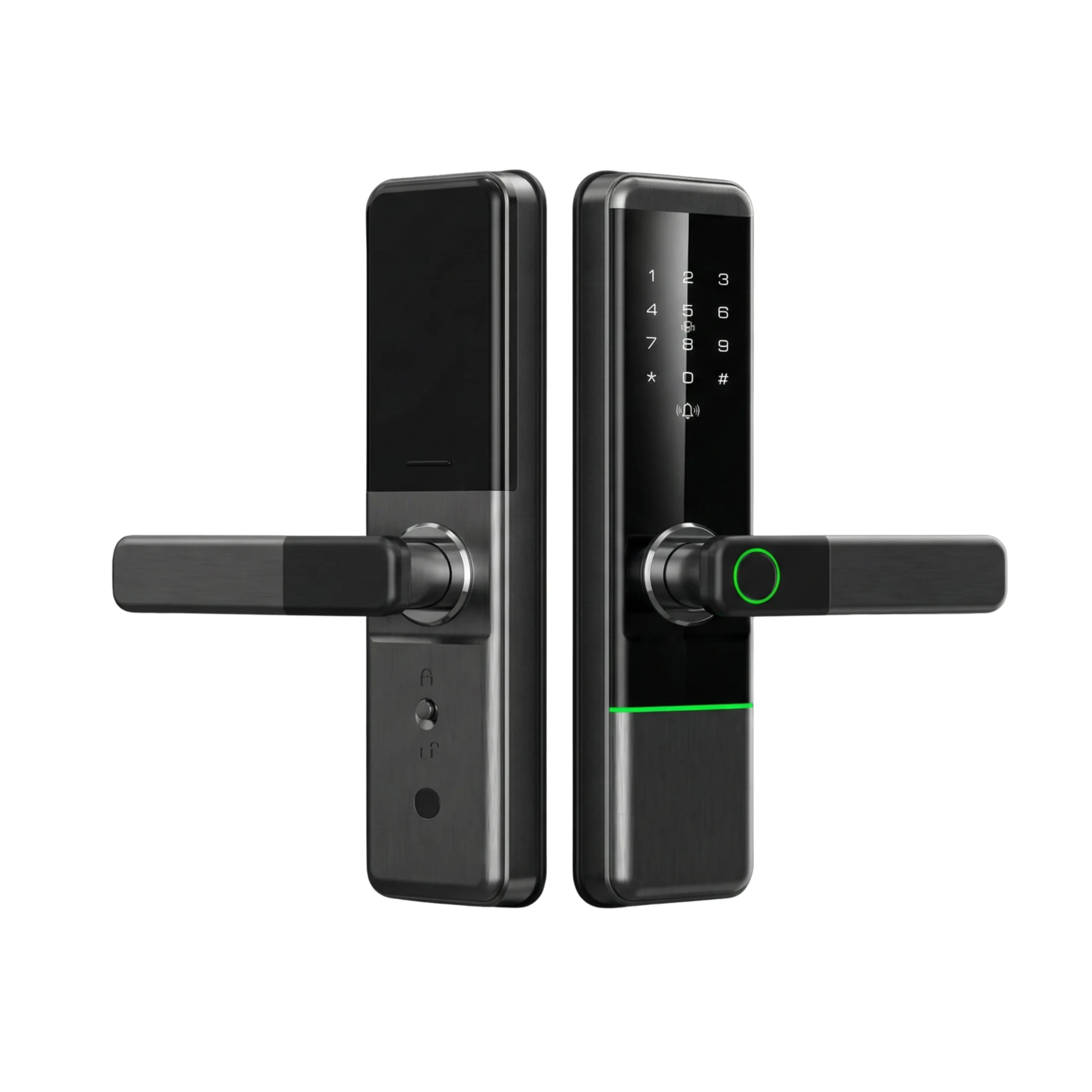
The V7 Max isn’t a normal smart lock. It runs palm vein, finger vein and 3D face recognition, a video intercom with two HD cameras, and 5-inch touchscreens on both sides of the door. Every one of those draws well above a keypad and a fingerprint reader.
Vein recognition in particular is expensive to run. It works by illuminating tissue with infrared and reading what comes back, and that illumination costs real current on every attempt. Add two displays and a camera system and you have a lock that would, without intervention, need charging noticeably more often than a simpler model.
So the honest framing is this. AuraCharge isn’t making a normal lock magically better. It’s making an unusually power-hungry lock practical. That’s a reasonable engineering trade, and it changes the value calculation.
Compare a V7 Max without AuraCharge to a plain fingerprint lock like the X9 Pro and the X9 Pro wins on battery life comfortably. AuraCharge closes that gap. It doesn’t reverse it into an advantage over every simpler lock.
What is battery anxiety actually costing you?
Worth doing the arithmetic before you spend money to make the feeling go away.
A set of four AA alkalines costs roughly AED 20 to 30, and that’s our own estimate rather than a listed price, because we don’t stock batteries. Most locks want changing once or twice a year. Call it AED 40 to 60 a year.
The V7 Max at AED 4,399 sits AED 2,799.01 above the Lockin SV40 at AED 1,599.99. At AED 50 a year, that premium buys you somewhere near fifty years of batteries.
Nobody sane buys this lock for the batteries, and if that’s your only complaint, this isn’t your answer. What you’re buying at AED 4,399 is the triple biometrics, the intercom and the screens. AuraCharge is what makes that stack livable. Read it as an enabler, not as the product.
The other half of battery anxiety is cheaper to fix than people think. Most of it is really the fear of being locked out, and that’s solved by a working backup credential and a plan, not by a better battery. We’ve written the full version of that in our emergency access guide.
What AuraCharge genuinely solves
The degradation curve, not just the dead battery. This is the underrated benefit. Biometric sensors don’t fail cleanly at zero. They get worse as voltage sags. IR emitters dim, image contrast drops, and match rates fall well before any low-battery warning appears. Owners experience this as “the lock has got unreliable lately” and usually blame the sensor. Keeping the pack near full keeps sensor performance consistent.
Properties you’re not at. Holiday homes, second properties, units you rent out. A lock that self-maintains removes a recurring visit.
Multi-door buildings. When you manage twelve doors, battery management is a real operational cost. Removing it compounds in a way it doesn’t for a single family home.
What it doesn’t solve
- Battery ageing. Lithium cells degrade over years regardless. Trickle charging doesn’t stop chemistry.
- Heat. Heat is the enemy of battery longevity, and a UAE exterior door in summer is a hot place. A charging system that keeps a cell topped up while it sits hot isn’t a cure for thermal stress. This is a real consideration on a fully sun-exposed door, and Lockin publishes no operating temperature range we can point you to.
- A blocked beam. Put a coat rack in the path and you’re back on battery with about a week of reserve.
- Every other failure mode. Mechanical misalignment, Wi-Fi dropouts, a sensor caked in dust. None of these are power problems and none are fixed by charging. Most “my lock stopped working” cases we see are network issues or sensor placement and cleanliness.
- Your obligation to keep a backup. Mechanical key somewhere sensible, and a PIN that works. Always.
Does it fit a UAE door?
Most international coverage of this lock lands on the same objection, and it doesn’t travel to the UAE.
The V7 Max is a mortise lock. In the United States that’s close to a dealbreaker, because American residential doors are pre-bored with a round hole for a cylindrical deadbolt, and fitting a mortise body means routing out a rectangular pocket or buying a new door slab. Reviewers there mark it down hard for that reason.
Here it’s the normal case. Mortise bodies are what villa and apartment entrance doors in the UAE are generally built for, which is why we sell mortise fitting as a listed service: AED 450 in Dubai and Sharjah, AED 550 in Abu Dhabi and the other emirates. It still needs measuring, because backset and centre distance vary and a mortise pocket isn’t a standard size. Send us a photo of the door edge with the existing lock body out, or ask us and we’ll tell you what to measure.
So in the UAE the door isn’t the blocker. The socket is. That’s the reverse of how this lock reads everywhere else, and it’s the single most useful thing to know before you order one.
Who should buy it, and who shouldn’t?
Buy the V7 Max if you want the triple-biometric setup and video intercom in the first place, and you’re going to have every one of those sensors on the door regardless. In that scenario AuraCharge is what makes the configuration livable, and it’s money well spent.
Don’t buy it for AuraCharge alone. If what you need is fingerprint and PIN on an apartment door, a simpler lock on a good battery will go a long time between charges and cost substantially less. Buying a power solution for a power problem you wouldn’t otherwise have is circular.
Don’t buy it if your hallway fails the four-metre test, and don’t buy it planning to “sort the socket out later”. Without the transmitter you’ve bought an extremely expensive lock that needs charging more often than a cheap one.
Consider the middle of the range instead if you want vein recognition without the intercom and dual displays. The V5 Max at AED 2,659.99 gives you palm vein and 3D face without the same draw. The SV40 at AED 1,599.99 gives you finger vein in a simpler, elder-friendly package. Our walk through the full Lockin range sets out where each one sits.
And if battery anxiety is your main concern and the rest of the feature list isn’t, you’ll get further by buying fewer features than by buying a cleverer way to power them all.
Buy the Lockin that matches how much lock you need
-


How can Altix help?
Send us two photos on WhatsApp: your door edge, and your entrance hall showing the nearest socket. We’ll tell you whether the mortise pocket suits the V7 Max, whether your hallway passes the four-metre line-of-sight test, and whether you’d be better served by the V5 Max or the SV40 at a third of the price.
Fitting is at our listed prices, AED 450 for a mortise lock in Dubai and Sharjah and AED 550 in Abu Dhabi and the other emirates. We’ll quote the fitting before the visit, not after.
FAQ
What happens to the V7 Max in a power cut?
The transmitter stops, so the charging stops. Lockin says the internal battery carries the lock for about a week from there. We haven’t tested that figure ourselves. After that you’re on the mechanical backup, same as any other lock.
Does the transmitter have to be in the same room as the door?
It needs a clear line of sight to the inside panel from up to 4 metres, so in practice yes. It can sit on a table or mount on a wall, and it has to be indoors and plugged into mains power.
Is the infrared beam safe around children and pets?
Lockin publishes eye-safe certifications from TÜV Rheinland and SGS for the beam. That’s the manufacturer’s certification and we’re repeating it rather than verifying it. If this matters to you, ask us and we’ll get the certificate references in writing before you buy.
Will it fit my Dubai apartment door?
Probably, because it’s a mortise lock and UAE entrance doors are generally built for mortise bodies. That’s the opposite of the problem it has in the US market. It still needs measuring for backset and centre distance, so send us a photo before you order.
Does it work with Apple Home Key?
It connects through Matter, so it works with Apple Home, Google Home, Alexa and SmartThings. Apple Home Key, meaning tapping your iPhone or Watch on the lock, is a separate feature and this lock doesn’t have it. If that’s what you want, see our guide to Apple Home Key locks in the UAE.
Is AED 4,399 worth it just to stop changing batteries?
No. At our own estimate of AED 40 to 60 a year in alkalines, the premium over the SV40 buys roughly fifty years of batteries. Buy this lock for the triple biometrics, the intercom and the screens, and treat the charging as what makes that stack practical.
What if someone puts furniture in front of the transmitter?
The beam is blocked and the lock runs on its internal battery until the path is clear. It’s not a failure, but it does mean the “never think about power again” promise depends on a piece of your hallway staying empty.
Do you install it, and what does it cost?
Yes. AED 450 in Dubai and Sharjah, AED 550 in Abu Dhabi and the other emirates, at our listed service prices. We’ll also site the transmitter and check the beam path as part of the same visit.
Popular Post
View All Installation & DIY
Lockin App Won’t Connect to Wi-Fi? It’s Almost Always the 2.4GHz Problem
Smart locks only speak 2.4GHz, and UAE ISP routers hide that band behind one combined network name. Why…
Read More Info → Security & Safety
Are Smart Locks Secure? Myths vs. Reality (Expert Breakdown)
Are smart locks secure for real homes and properties in Dubai and Abu Dhabi?For most households, rentals, and…
Read More Info → Apartments & Villas
How to control Smart Locks with Alexa, Google Home
Smart locks aren’t just about replacing keys, they’re about convenience. One of the biggest advantages of choosing the…
Read More Info → How-to
Tuya vs TTLock – Which App is best?
Tuya vs. TTLock: Which Smart Lock Platform Should You Choose for Your Home? Smart locks are becoming more…
Read More Info →
Smart Locks in UAE: The 2026 Buyer’s Guide You Actually Need
If you’re upgrading security in your home, villa, or office in the UAE, the smartest move in 2026…
Read More Info → Wi-Fi, Remote & Smart Home
Bluetooth vs Wi-Fi Locks – Which One Fits Your Space?
Should your smart lock work only when you are standing at the door, or should it let you…
Read More Info →