



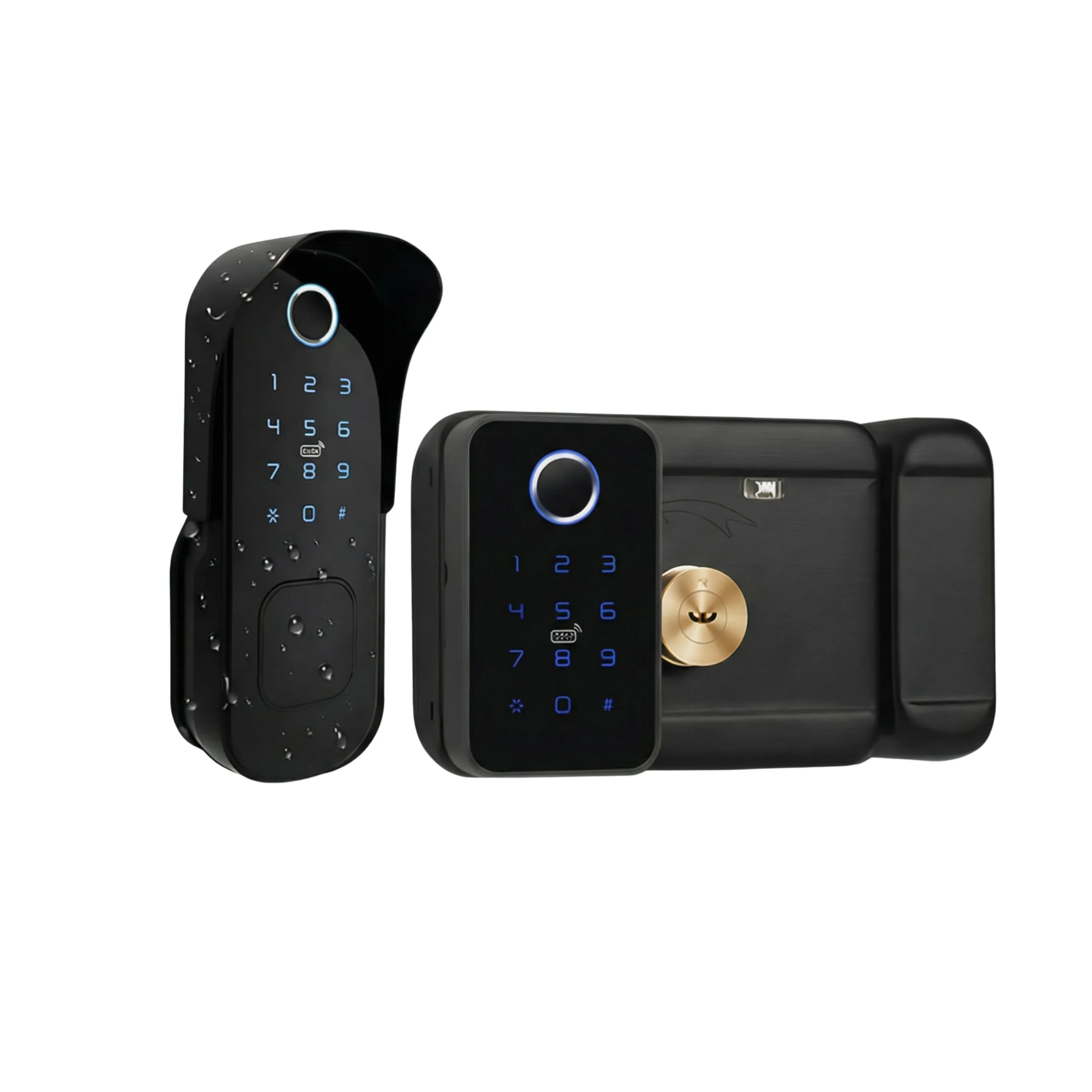
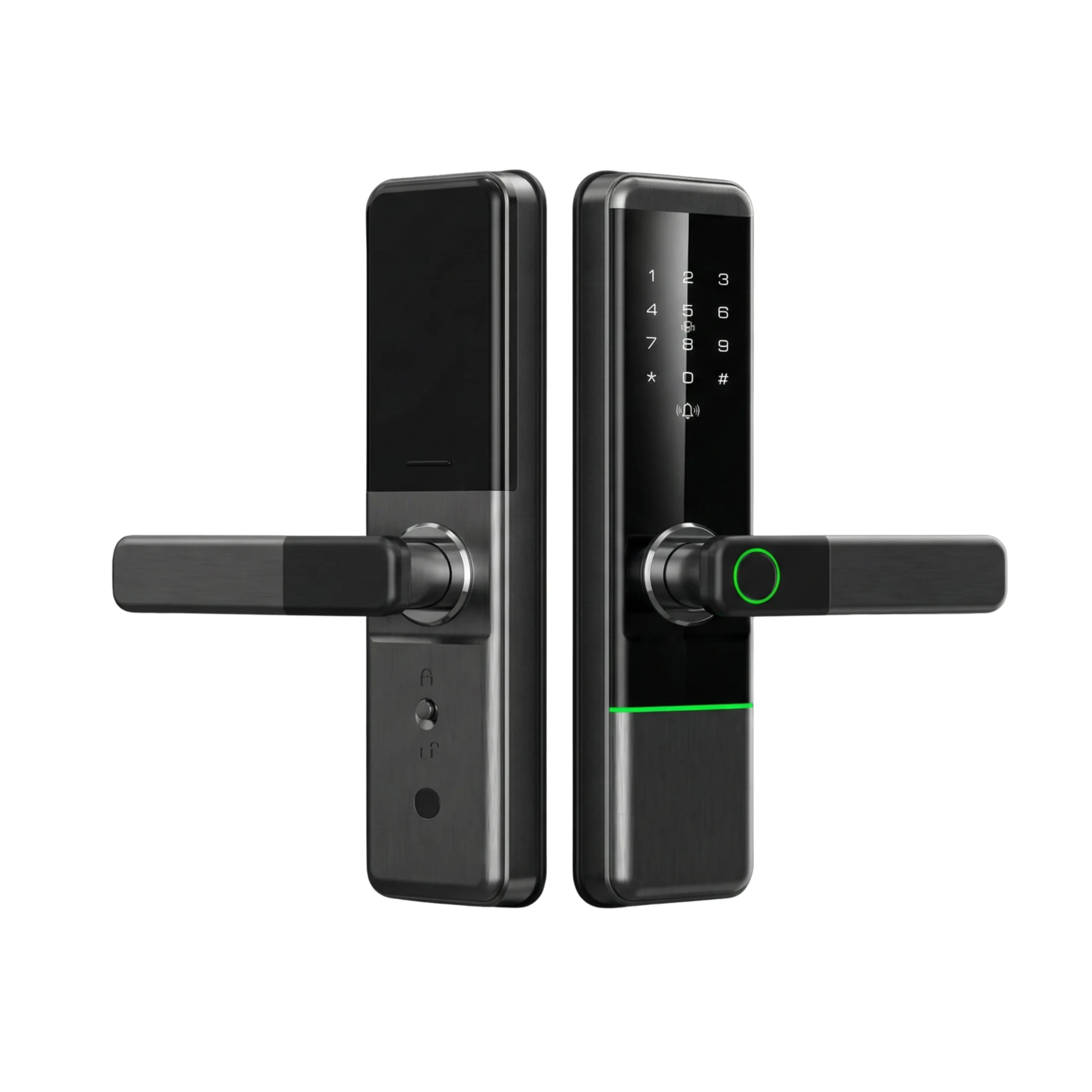









There’s no single number, and anyone who gives you one is guessing. A smart lock is four separate things bolted together, and they age at completely different speeds. The steel in your door will outlive you. The circuit board behind the keypad is on a heat clock. The battery compartment is on a corrosion clock you control. And the app is on somebody else’s clock entirely.
In our experience fitting and servicing these across Dubai, Sharjah and Abu Dhabi, the mechanical part almost never ends a lock’s life. Heat, a leaked battery, or a discontinued app does.
Other sellers publish 3 to 7 years, or 5 to 10, or 10 to 15. We looked at where those figures come from and there’s no test behind any of them. So we’re not going to add a fifth number to the pile. The component breakdown below is the part you can act on.
What are the four parts of a smart lock, and how long does each one last?
| Part | What wears it out | Realistic life on a UAE home door | Can you do anything about it? |
|---|---|---|---|
| Mortise body, latch, bolt, cam | Mechanical cycles | Decades. See the arithmetic below | Barely matters. It isn’t the problem |
| Circuit board, motor, sensor, screen | Heat, mostly | Varies by a factor of five depending on where the door faces | Yes. Shade and door choice decide it |
| Battery compartment and contacts | Leaked alkaline electrolyte | Indefinite if you’re careful. One weekend if you’re not | Yes, completely |
| App, cloud account, phone OS support | The manufacturer’s commercial decisions | Unknowable, and not yours to decide | Only at the point of purchase |
Why the mortise body isn’t what fails
Locksets get graded for durability by cycle test under the ANSI/BHMA A156 series. A Grade 1 bored lockset is tested to roughly 800,000 cycles, Grade 2 to 400,000 and Grade 3 to 200,000. A Grade 1 mortise lock is tested to a million.
Now put a UAE family behind it. Say ten open and close cycles a day, which is generous for a two-bedroom apartment in Jumeirah Village Circle. That’s 3,650 a year.
- Grade 3 at 200,000 cycles: about 55 years
- Grade 2 at 400,000 cycles: about 110 years
- Grade 1 mortise at 1,000,000 cycles: about 274 years
Even a holiday home doing 30 cycles a day gets 18 years out of the weakest grade. So when someone tells you their smart lock “wore out” after four years, the steel didn’t wear out. Something else did.
One honest caveat: most smart locks sold in the UAE, ours included, don’t publish an ANSI/BHMA grade at all. We flagged that in our buying red flags article. The arithmetic above still holds because even ungraded mortise bodies are built from the same zinc alloy and steel, but treat it as an order of magnitude rather than a certificate.
Why does the same lock last longer on one door than another?
Because of heat, and the maths on this is steeper than most people expect.
The standard engineering rule for the parts of a circuit that age fastest with temperature is the Arrhenius relationship: life doubles for every 10°C you drop below the rated temperature, and halves for every 10°C you go up. For aluminium electrolytic capacitors the mechanism is physical, the electrolyte slowly evaporates out through the rubber end seal, and it evaporates faster when it’s hot.
Take a component rated for 2,000 hours at 105°C and run the numbers.
| Board temperature | Multiplier | Equivalent life |
|---|---|---|
| 45°C | 64x | About 14.6 years |
| 55°C | 32x | About 7.3 years |
| 65°C | 16x | About 3.7 years |
| 75°C | 8x | About 1.8 years |
Twenty degrees turns fifteen years into under four. A lock in a shaded lobby corridor and the same lock on a west-facing villa door in Al Furjan are sitting in different rows of that table.
And UAE doors get there easily. Midday temperatures run 44 to 47°C through the summer. Metal in direct sun sits well above ambient, commonly reported at 60°C and up, and a closed car interior reaches around 70°C. A dark aluminium door taking four hours of afternoon sun is closer to the car than to the air temperature.
Two things we have to be straight about. First, we haven’t opened up every model we sell to inventory what’s on its board, and plenty of low-power designs use ceramic capacitors that don’t age this way. Second, capacitors aren’t the only thing heat attacks. Silicone keypad membranes, adhesives, LCD panels and the seal around the fingerprint sensor all have their own heat clocks. So read the table as the shape of the curve, not as a prediction for your specific lock. What it explains is why two identical locks fitted on the same day, one facing north and one facing west, are in completely different condition four summers later.
If your door is near the coast, heat is the second problem and salt is the first. That’s covered separately in why IP66 doesn’t mean salt-proof.
What actually kills smart locks in the UAE?
Ranked by how often we see it.
| Symptom | Usual cause | Is it fixable? | Cost |
|---|---|---|---|
| Lock completely dead, white crust in the battery bay | Alkaline leakage corroding the contacts | Almost never | New lock |
| Fingerprint reads fail, keypad works | Sensor surface or the finger, not the lock | Usually, and often free | AED 0 to 34.99 |
| Motor strains, lock jams intermittently | Door or frame alignment, not the lock | Yes, alignment job | Callout |
| Screen dim or dead, everything else works | Heat ageing on the display | No | New lock |
| App won’t connect, Bluetooth still works | Gateway, Wi-Fi, or the platform | Usually | AED 0 to 179.99 |
| Works fine, but the app is discontinued | Manufacturer’s decision | No | New lock |
How to stop a leaking battery from killing the lock
This is the one failure that’s on the owner rather than the manufacturer, and it’s the one we see most. Alkaline cells leak potassium hydroxide. It’s strongly caustic, it creeps along the spring contacts, it eats solder joints and copper traces, and it attacks the plastic of the compartment itself. Once it reaches the board, the lock is finished. Heat accelerates the whole process, which is why a set of cells left in over a Dubai summer is a different risk from the same cells in a European hallway.
Preventing it costs nothing:
- Replace all cells at once, same brand, same date
- Don’t mix alkaline with rechargeable, or old with new
- Take the batteries out before you leave the country for the summer
- Open the bay and look at it every time you change cells, not just when something goes wrong
- If you see any white powder at all, that lock is on borrowed time, start planning
We wrote the battery timing side of this separately in smart lock battery life and the wider routine in smart lock maintenance.
Rechargeable locks dodge the leakage problem and pick up a different one. Lithium cells lose capacity fastest when they’re hot and held at a high state of charge, and the effect isn’t small. In one published study a cell at 40°C and full charge fell below 80% of its original capacity in just over two months, against five months at 25°C. Those are lab cells, not door locks, so read it as direction rather than a rate for your model. The practical version is simple. A rechargeable lock on a hot door will hold less charge in year three than it did in year one, and there’s nothing you can do except not leave it sitting at 100% in July.
What happens when the manufacturer discontinues the app
This is the clock nobody selling locks mentions. The lock in the door is fine. The company decides to stop paying for the servers, and the lock stops being smart.
This isn’t theoretical. Belkin announced in July 2025 that it would stop supporting most Wemo products, and cloud and app support ended on 31 January 2026. ASSA ABLOY shut down Kevo in November 2025. Smaller vendors have simply switched off an application server and left owners with a keypad that no longer talks to anything.
We sell locks on TTLock, Tuya, EZVIZ, Aqara, SwitchBot and Solity. We can’t promise you what any of those companies will be doing in 2034, and neither can anyone else selling to you. What we can tell you is what to check before you buy:
- Does the lock still open on Bluetooth and keypad with no internet at all? If it does, a dead cloud costs you remote access, not entry.
- Is there a mechanical key override? On the EZVIZ DL03 Pro there isn’t, which we’ve said in print.
- Is the platform used by more than one brand? A shared platform has more customers keeping it alive than a single manufacturer’s private app.
- How many phone OS generations back does the app still support?
Can you replace just the broken part?
In this market, mostly no, and we’re not going to pretend otherwise.
We don’t stock spare front panels. We don’t stock replacement mortise bodies on their own. We don’t stock battery contact assemblies. Neither does any UAE retailer we’re aware of. When the electronics die on a mortise lock, the working steel body comes off the door with it and goes in the bin. That’s a real waste and we’d rather it weren’t the case, but a post that told you to “just order a replacement panel” would be sending you somewhere that doesn’t exist.
Which changes the buying decision, not the repair decision. If nearly every failure ends in a whole new lock, then the thing that controls your ten-year cost is how much of the lock has to be thrown away each time.
That’s the argument for the two routes that keep the expensive, long-lived part in the door.
A smart cylinder. The Altix CL1X at AED 504.99 replaces the euro cylinder inside your existing mortise body. The steel stays in the door. When the electronics go, you swap a cylinder, not a lockset, and the cylinder fitting SKU is cheaper than the mortise one.
A retrofit over the deadbolt. The SwitchBot Lock Pro at AED 509.99 mounts on the inside face of the door and turns the existing thumbturn. Two things follow from that. The mechanical lock is untouched, and the electronics sit indoors in air conditioning instead of in direct sun. On the heat table above, that’s the difference between the 45°C row and the 65°C row.
The honest limit on both: most UAE apartment doors are handle-and-mortise, not deadbolt-and-thumbturn, so the retrofit route isn’t available to a lot of readers. And a cylinder swap needs a euro-profile cylinder in the first place. Send us a photo of your door edge and the inside face and we’ll tell you which of the three routes you actually have. We cover the mortise and cylinder distinction in more detail in can a smart lock replace my mortise lock.
What does replacing a smart lock cost in the UAE?
Prices and stock read live from our own catalogue on 16 September 2026.
| What happened | Hardware | Fitting | Total |
|---|---|---|---|
| Batteries only | AED 20 to 30 (our estimate, not a listed SKU) | You | AED 20 to 30 |
| Mortise lock dead, like for like, Dubai or Sharjah | Altix R9 AED 494.99 | AED 450 | AED 944.99 |
| Mortise lock dead, like for like, Abu Dhabi | Altix R9 AED 494.99 | AED 550 | AED 1,044.99 |
| Mortise lock dead, refurbished replacement | Refurbished Altix RX AED 389.99 | AED 450 | AED 839.99 |
| Cylinder route, Dubai or Sharjah | Altix CL1X AED 504.99 | AED 350 | AED 854.99 |
| Retrofit route, deadbolt door | SwitchBot Lock Pro AED 509.99 | You, about 20 minutes | AED 509.99 |
| Remote access on any of the above | G2 gateway AED 179.99 | You | AED 179.99 |
Those fitting figures are our four listed service prices, and they’re what binds when you book with us. Our older installation cost article quotes AED 150 to 350 as the market range generally, which is a different thing from our own rate card.
Two notes on the refurbished line. It saves you AED 105 against a new R9, which is less than one fitting callout, so it only makes sense if the unit goes in first time. And our refurbished stock is thin, one unit each on the RX and GX Pro as of today. The full argument is in buying a refurbished smart lock.
Before you replace anything, check it’s the lock
We’d rather talk you out of a AED 945 job than sell you one you didn’t need. Three things account for most of the “my smart lock is dying” calls we get, and none of them is a dying lock.
The door moved, not the lock. Aluminium and steel doors expand through the summer and frames settle. A latch that’s fighting a misaligned strike plate makes the motor work harder, drains the battery faster, and sounds exactly like a failing lock. Open the door fully and operate the lock with nothing to push against. If it’s smooth and quiet in mid-air and rough in the frame, it’s an alignment job.
The finger changed, not the sensor. Wudhu five times a day, AC-dried skin, henna, cleaning chemicals. Test with three different people before you condemn the reader. The full diagnostic is in when fingerprints stop working, and for most households the fix is a AED 34.99 card set rather than a new lock.
The network changed, not the lock. New router, new Wi-Fi password, or a 5GHz-only band. If Bluetooth still opens the door standing next to it, the lock is fine and the gateway is the problem.
A worked replacement: fingerprint lock dies on a Thursday in JVC
Four-year-old mortise lock, west-facing apartment door, Jumeirah Village Circle. This is how it ran.
- Thursday 19:40. Keypad lights up, fingerprint gives three long beeps, code entry does nothing. Resident uses the mechanical key and gets in.
- Thursday 19:50. Fresh batteries in. Same behaviour. So it isn’t the cells.
- Thursday 19:55. Torch into the battery bay. Two spring contacts have white crust on them and one is pitted. That’s leaked alkaline, and that’s the answer.
- Thursday 20:10. Photos on WhatsApp: the battery bay, the door edge showing the mortise faceplate, the inside face, and a tape measure across the door thickness.
- Friday 09:30. We read the faceplate and the handle centres off the photos and confirm it’s a 6068 mortise body, 40mm leaf. Like-for-like swap, no machining.
- Friday 09:45. Three routes quoted. New R9 at AED 494.99 plus AED 450 fitting. Refurbished RX at AED 389.99 plus the same fitting. Or, since this door has a handle and not a thumbturn, no retrofit option. Resident picks new.
- Friday 10:00. Slot booked for Saturday morning. Resident is told to keep using the mechanical key and not to leave the flat unlocked on the latch.
- Saturday 09:15. Technician arrives. Old lock off in about 15 minutes. The mortise body itself is in fine condition, because four years of a family opening a door hadn’t touched it.
- Saturday 09:40. New unit in, handle and latch tested with the door open, then closed. Strike plate adjusted by 2mm because the frame had moved.
- Saturday 10:00. Credentials enrolled. Four fingerprints, two codes, two cards. Admin account created in the resident’s name, on the resident’s phone, not ours.
- Saturday 10:10. Old lock’s account unbound and deleted before the unit leaves the flat, so nothing stays paired to a lock sitting in a bin. Invoice issued with the lock, the service line and VAT itemised.
The job came to AED 944.99 on the door, itemised with VAT. From the lock dying to the lock working was about 62 hours, and most of that was the weekend.
Two things come out of that. The mechanical body was fine and got scrapped anyway, because nobody sells the panel separately. And step 11 matters more than people think. A lock you throw away while it’s still bound to your account is a loose end, and it’s the same account-binding trap we wrote about in the refurbished article.
Which lock should you buy if you want to replace less often?
| Priority | What to buy | Why |
|---|---|---|
| Door gets direct afternoon sun | Anything that publishes an operating temperature range | Most brands don’t publish one at all. EZVIZ does |
| You have a deadbolt and thumbturn | Retrofit over the existing lock | Electronics live indoors, mechanical lock never gets replaced |
| You have a euro cylinder in a mortise body | Smart cylinder | Swap the cylinder, keep the steel, cheaper fitting |
| Renting and moving in 18 months | Retrofit or cylinder | Reverses cleanly, see our switch back guide |
| You want the lowest ten-year cost | Retrofit, then cylinder, then mortise | In that order, because it’s how much gets thrown away each time |
| You care about app longevity | A platform used by several brands | More customers keeping the servers on |
On the first row: the EZVIZ DL05 at AED 499 publishes its operating range, its door thickness range and its lock body size, which puts it ahead of most listings including some of our own. We said so in print in our red flags article and we’ll keep saying it until our product pages catch up.
Buy the lock that replaces the cheap part, not the door
-

 Bestseller

How can Altix help?
Send us a photo of your door edge, the inside face and the battery bay on WhatsApp. We’ll tell you three things before you spend anything: whether the lock is actually dead, whether the mortise body can stay, and which of the three replacement routes your door allows.
If it turns out to be alignment or a card set, we’ll say so and you’ll have spent nothing. If it’s a replacement, you get the fitting price before the visit, not after.
FAQs
How long should a smart lock last in Dubai?
On a shaded or indoor-facing door, with the battery bay kept clean, we’d expect the electronics to outlast the warranty by a wide margin. On a west-facing exposed door in full summer sun, expect materially less. We won’t give you a single year figure, because the same lock on two different doors gives two different answers.
My lock is four years old and the fingerprint stopped working. Do I need a new one?
Probably not. Test the reader with three different people first. If it works for someone else, the lock is fine and the finger is the problem, and a card set at AED 34.99 solves it.
Is a dead smart lock covered by warranty?
Depends on the age, the cause and what the manufacturer’s terms say. Battery leakage damage is usually excluded everywhere. Our warranty article covers what’s protected and what voids it, and get anything you’re told verbally put in writing on the invoice.
Can you repair a smart lock instead of replacing it?
Alignment, credential and connectivity problems we fix. Board-level failures we don’t, because nobody in this market supplies spare panels or boards for these units. If a seller tells you they’ll repair the electronics, ask where the part is coming from.
What happens to my lock if the company shuts down the app?
If the lock opens on keypad, card, fingerprint or Bluetooth without internet, you lose remote access and keep entry. If it depends on the cloud to open, you lose the lock. Ask which one you’re buying before you pay.
Does the UAE summer really shorten the life that much?
Heat is the single biggest variable we see. The engineering rule is that the heat-sensitive parts of a circuit halve their life for every 10°C rise, and a dark door in Dubai afternoon sun runs far hotter than the air temperature. It’s the reason a shade, a porch or an inward-facing door is worth more than any spec on the box.
Should I take the batteries out if I’m away for the summer?
Yes, if nobody needs to get in while you’re away. Cells sitting in a hot compartment for three months is the exact condition that produces leakage, and leakage is the failure we can’t fix.
Is it cheaper to replace the whole lock or upgrade to a retrofit?
On a deadbolt door, the retrofit is cheaper twice over. AED 509.99 with no fitting charge against AED 944.99 fitted for a mortise unit, and next time around you replace a module instead of a lockset. The catch is that it only works on deadbolt and thumbturn doors, which a lot of UAE apartments don’t have.
Popular Post
View All Installation & DIY
Lockin App Won’t Connect to Wi-Fi? It’s Almost Always the 2.4GHz Problem
Smart locks only speak 2.4GHz, and UAE ISP routers hide that band behind one combined network name. Why…
Read More Info → Security & Safety
Are Smart Locks Secure? Myths vs. Reality (Expert Breakdown)
Are smart locks secure for real homes and properties in Dubai and Abu Dhabi?For most households, rentals, and…
Read More Info → Apartments & Villas
How to control Smart Locks with Alexa, Google Home
Smart locks aren’t just about replacing keys, they’re about convenience. One of the biggest advantages of choosing the…
Read More Info → How-to
Tuya vs TTLock – Which App is best?
Tuya vs. TTLock: Which Smart Lock Platform Should You Choose for Your Home? Smart locks are becoming more…
Read More Info →
Smart Locks in UAE: The 2026 Buyer’s Guide You Actually Need
If you’re upgrading security in your home, villa, or office in the UAE, the smartest move in 2026…
Read More Info → Wi-Fi, Remote & Smart Home
Bluetooth vs Wi-Fi Locks – Which One Fits Your Space?
Should your smart lock work only when you are standing at the door, or should it let you…
Read More Info →