












An IP66 rating tells you a lock is dust-tight and survives a powerful jet of clean water. It tells you nothing about salt. The standard behind it, IEC 60529, contains no corrosion test at all. Two locks can both carry IP66, and one of them can be dead on a Palm Jumeirah pool gate inside two years while the other holds fine on a Mirdif front door.
If your door sits within a few hundred metres of the Gulf, you’re shopping on a number that doesn’t measure the thing that will kill your lock. We’ve written separately about what IP ratings do cover for Dubai conditions. This one is about what they leave out.
What does an IP66 rating cover?
Two digits, two tests, both run once on a new sample.
The first 6 means dust-tight, with no ingress at all after eight hours in a dust chamber. The second 6 means the lock takes water from a 12.5 mm nozzle at roughly 100 litres per minute, at 100 kPa, from three metres, for at least three minutes, from every direction.
That water is clean, fresh and at room temperature. No salt. No wet-dry cycling. No UV. No ten-year clock. It’s a sealing test on a brand new unit, and a useful one, but it answers the question “can water get inside?” rather than “will this thing rot?”
| What IP66 tells you | What IP66 says nothing about |
|---|---|
| Dust can’t get inside the housing | Whether the housing corrodes |
| Fresh water jets won’t penetrate the seals | Whether chloride attacks the metal |
| The unit sealed correctly when new | Whether it still seals after three years of UV and heat cycling |
| Gasket geometry works | Gasket material, and how fast it hardens |
| Nothing at all about screws and fixings | The screws are usually what fails first |
NEMA 250 does cover corrosion. It adds an “X” suffix, as in 4X, verified with a salt-spray protocol. The test is ASTM B117: continuous 5% salt fog at 35°C, reported as the number of hours before rust appears. That’s the number you want on a coastal door, and almost nobody in the residential smart lock category publishes it. We don’t either, and we’ll come back to that below.
What kills smart locks on UAE beachfront doors?
Chloride corrosion. The reason it’s so aggressive here is humidity rather than the salt on its own.
Sea spray drifts inland and lands on your door as a fine salt film. Salt is hygroscopic, so it pulls moisture out of the air. Dubai coastal summer humidity sits around 80 to 85%, and Jumeirah beachfront runs near 85% in July. Overnight, coastal humidity climbs past 80% almost every night of the year.
So the salt film on your lock never dries. It stays as a conductive liquid sitting directly on the metal, around the clock, for months. Corrosion engineers call that time of wetness, and it’s the biggest single reason a coastal door and an inland door age at completely different rates. The lock isn’t being splashed now and then. It’s permanently sitting in a thin electrolyte.
The failures arrive in a fairly consistent order.
- Fixings. The two through-bolts and the strike plate screws go first. Carbon steel with a zinc plate, or low-grade stainless, will bleed rust streaks down your door long before the lock stops working. Manufacturers rarely specify fastener grade, because fasteners are the cheapest part in the box.
- The seam. The joint where the front panel meets the door face. The gasket compresses, hardens under UV and heat, then stops sealing. Salt water wicks in behind the panel and sits there, out of the wind and out of the sun, which is the worst place it could be.
- The body. Most lock bodies in this price range are zinc alloy, usually a Zamak grade, with a plated or coated finish. Zinc handles general weather well. Under a permanent salt film it develops white corrosion product, a chalky bloom, and where the coating has a pinhole or a scratch it pits straight through.
- The galvanic pair. Stainless screws into an aluminium door make a galvanic couple. In dry air that’s fine. In a chloride electrolyte the aluminium turns anodic and pits at the contact point, so your door frame corrodes around a screw that still looks perfect. On aluminium villa doors in JBR and on the Palm this is common, and it damages the door rather than the lock.
- The electronics. Keypad edges, the RFID antenna window, battery contacts, and the emergency USB or Type-C port. Salt moisture doesn’t need to flood a PCB. A conductive bridge across two tracks is enough to cause phantom presses, dead zones on the keypad, or a lock that eats batteries in six weeks instead of eight months.
How far from the sea does salt matter?
Corrosion severity is classified under ISO 9223, which combines annual temperature, time of wetness and chloride deposition rate into categories from C1 to CX. C5 is “very high”, described as a coastal area with strong salinity influence.
Deposition falls off sharply with distance, but it depends on wind direction, topography and whether the coast is open. Within about 200 metres of open coast with an onshore wind, chloride deposition alone can put you in C5 regardless of anything else. Much of the UAE coastline sits at C4 and steps up to C5 on exposed frontage.
| Your door | Corrosion exposure | What to spec |
|---|---|---|
| Within ~50 m of open water, facing the sea (Palm frond tips, Saadiyat beachfront, Mina Al Arab canal-front, Fujairah east coast) | Highest. Direct aerosol plus permanent wetness | 316 fixings, isolating washers, silicone gasket, monthly rinse, budget for replacement |
| 50 to 200 m, or the landward face of a beachfront villa | High. Wind-carried aerosol | 316 fixings, quality gasket, quarterly rinse |
| 200 m to 1 km (most of JBR, Jumeirah 1-3, Al Sufouh, Corniche apartments) | Moderate. Salt still arrives on shamal winds | 316 or good 304 fixings, normal maintenance |
| Beyond 1 km, or fully sheltered (Arabian Ranches, Mirdif, Al Barsha, Khalifa City) | Low for salt. Heat and dust are your problems | Standard IP66 hardware is fine |
Two things people get wrong here. They protect the front door and ignore the pool gate, when the pool gate is usually the seaward one and it’s taking chlorinated splash on top of salt aerosol. And they assume a covered porch solves it. Shade helps with heat, but it also stops rain from rinsing the salt off, so a sheltered coastal door can accumulate more chloride than an exposed one. Cover plus a fresh water rinse is the combination that works.
Which materials and finishes hold up in salt air?
| Material or finish | How it behaves in coastal UAE | Where to use it |
|---|---|---|
| 316 stainless (with molybdenum) | Exceeds 1,000 hours in ASTM B117, resists chloride pitting and crevice corrosion | Screws, bolts, strike plates, exposed trim on seaward doors |
| 304 stainless | Typically 500 to 1,000 hours in open exposure, but pits under static salt in crevices | Acceptable past 200 m, risky on the frontage |
| Anodised aluminium | Good, provided the anodising is thick. Marine-grade specs call for around 25 microns | Lock bodies and door frames |
| PVD finish | Beats conventional plating in salt spray, and resists scratching so the coating stays intact | Handles, escutcheons, decorative faces |
| Zinc alloy with conversion coat and topcoat | Fine inland. Under a permanent salt film it blooms white, then pits at coating defects | Sheltered and inland doors |
| Chrome or nickel plated zinc | Weakest option here. Plating porosity lets chloride reach the substrate | Interior doors only |
Coating integrity matters more than the base metal. A scratch on a plated zinc lock, from a key, a ring or a delivery trolley, becomes the pit site. On the coast that scratch matters in a way it never would in Al Barsha.
What to ask before you buy a lock for a coastal door
Six questions. A seller who can’t answer them hasn’t specified for your exposure.
- What grade are the fixing screws? Ask for the number, not the word “stainless”. If nobody knows, assume they’re not 316 and plan to replace them.
- Does the manufacturer publish ASTM B117 salt-spray hours? In the residential category the honest answer is usually no. Anyone claiming marine certification without a test report is guessing.
- What’s the body material and finish? Anodised aluminium or PVD over stainless beats plated zinc on the frontage.
- What’s the gasket made of? Silicone or EPDM keeps its shape in UAE heat. Foam tape doesn’t.
- What operating temperature and humidity range does the manufacturer state? Most datasheets in this bracket quote an IP rating and skip these two figures. Ask anyway, and ask us too, because we’ve put the same question to our suppliers.
- Can you get spare parts in the UAE? A corroded strike plate is a AED 40 problem if the part sits in Dubai and a AED 800 problem if it doesn’t.
What this looks like on a real coastal villa
This is the pattern we see on the frontage rather than a lab result, so treat the timings as field expectation and not a specification.
Take a villa on a Palm Jumeirah frond. The main entrance faces the internal road, roughly 60 metres from the water, with the house itself between it and the sea. The pool gate faces open water at about 15 metres.
- Day one. Both doors get the same IP66 lock, with the standard fixings from the box. Same model, same install, same installer.
- Month 2. A faint rust weep appears under the two through-bolts on the pool gate. The front door is clean. Nothing works differently yet.
- Month 5. The pool gate keypad needs a firmer press in one corner. Salt has crept under the panel edge and the gasket has taken a heat set.
- Month 8. Battery life on the pool gate lock drops from about eight months to roughly ten weeks. That’s leakage current across a salt bridge, not a bad battery.
- Month 11. White bloom appears on the pool gate body around the handle base. The aluminium gate frame shows pitting at two screw holes, where stainless met aluminium with no isolating washer.
- Month 14. RFID reads go intermittent in the mornings, when overnight humidity has been highest. It works by 11am and fails again at 6am.
- Month 18 to 24. The pool gate lock gets replaced. The front door lock is still running normally with no visible corrosion.
- On replacement. 316 through-bolts and screws, nylon isolating washers at every aluminium contact, a silicone gasket bead behind the panel, marine grease on the cylinder, and a monthly fresh water wipe folded into the villa’s existing pool maintenance round. Same lock model, different service life.
Nothing was wrong with the lock. The same hardware in two positions 45 metres apart had two different jobs, and only one of them was specified for the job it got.
What does it cost?
| Line item | Typical cost |
|---|---|
| Altix RX Ultra, IP66 aluminium body, fingerprint, PIN, RFID, key and app | AED 764.99 |
| Altix WeatherShield, IP66, app, passcode, RFID, key, auto-lock, Type-C emergency power | AED 834.99 |
| Professional installation, per door | AED 150 to 350 labour |
| 316 stainless fixing set and nylon isolating washers | Usually under AED 100 |
| Silicone gasket and marine grease | Nominal, done at install |
| Fresh water rinse and inspection | Free if it joins an existing pool or garden round |
Under AED 100 on fixings and five minutes on gasket and grease at install costs less than a second lock at AED 765 plus another AED 250 of labour eighteen months later. On a seaward door, that comparison is the decision.
We’ve broken down what installation includes in our guide to smart lock installation costs in Dubai.
Which locks do we recommend for coastal doors?
We supply two IP66 models suited to exposed doors.
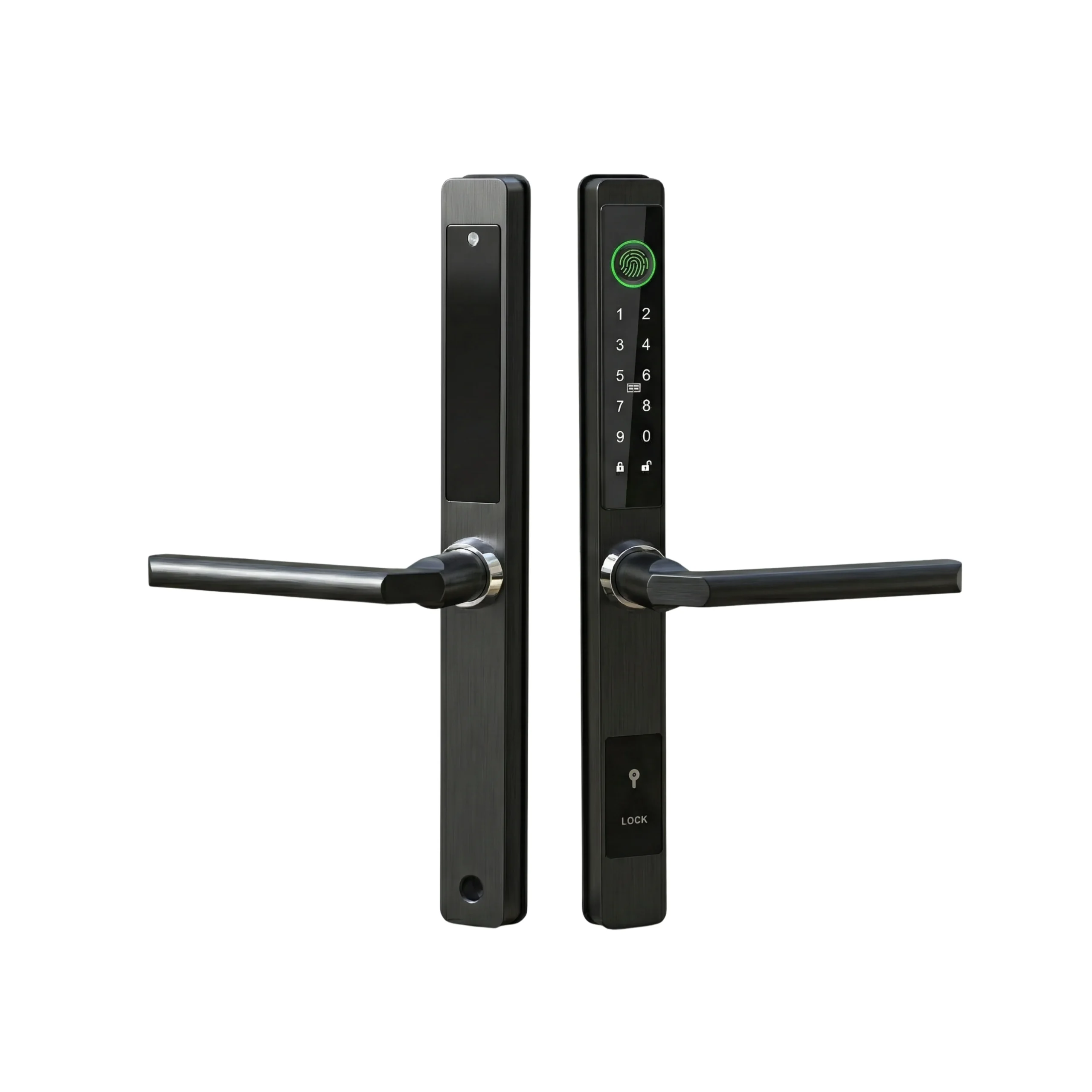
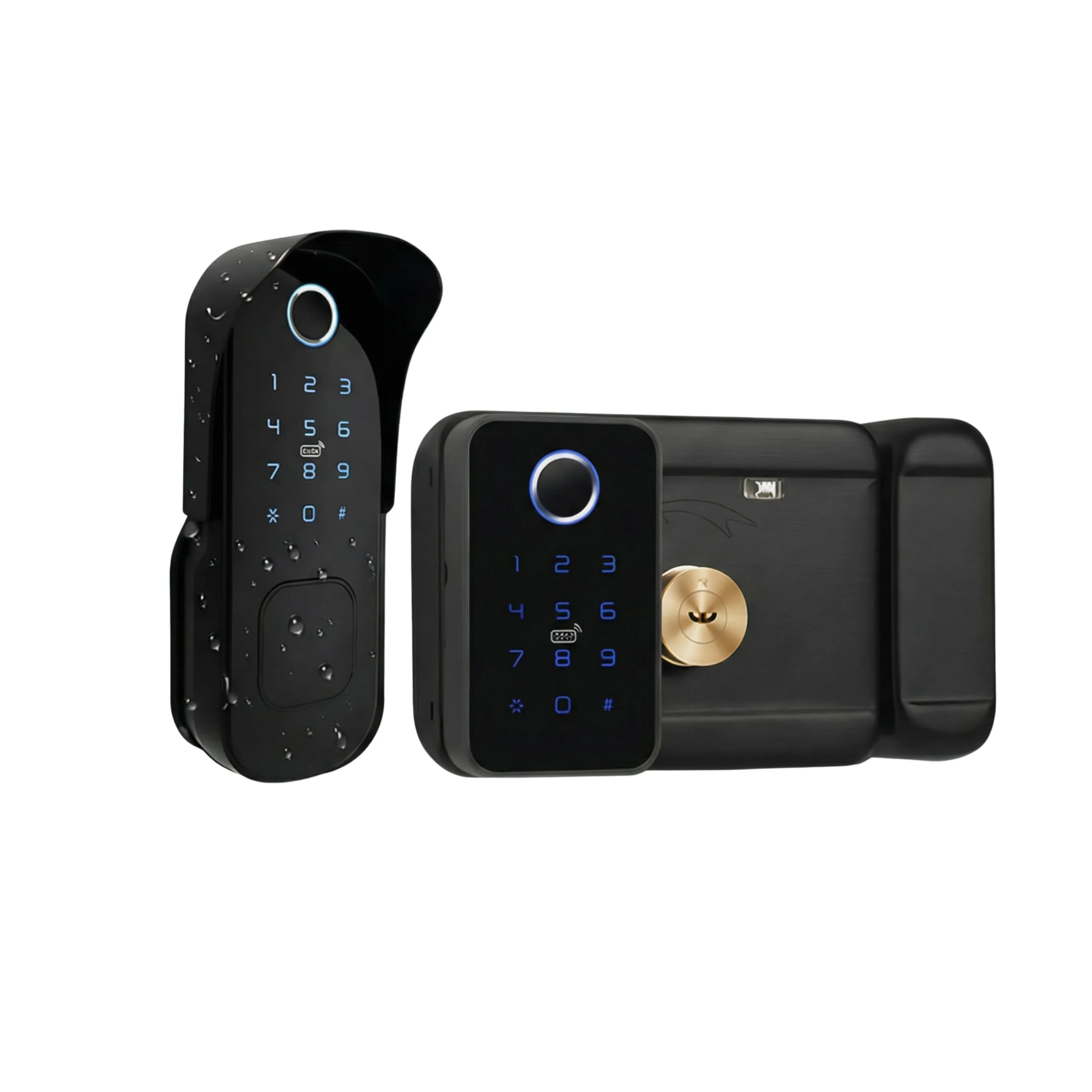
The Altix RX Ultra has an aluminium body and unlocks by fingerprint, PIN, RFID card, mechanical key or app. It fits aluminium, wooden and metal swing doors and ships with a 2585 mortise. It won’t work on sliding doors, and you should check your door’s lock body depth and centre alignment before ordering.
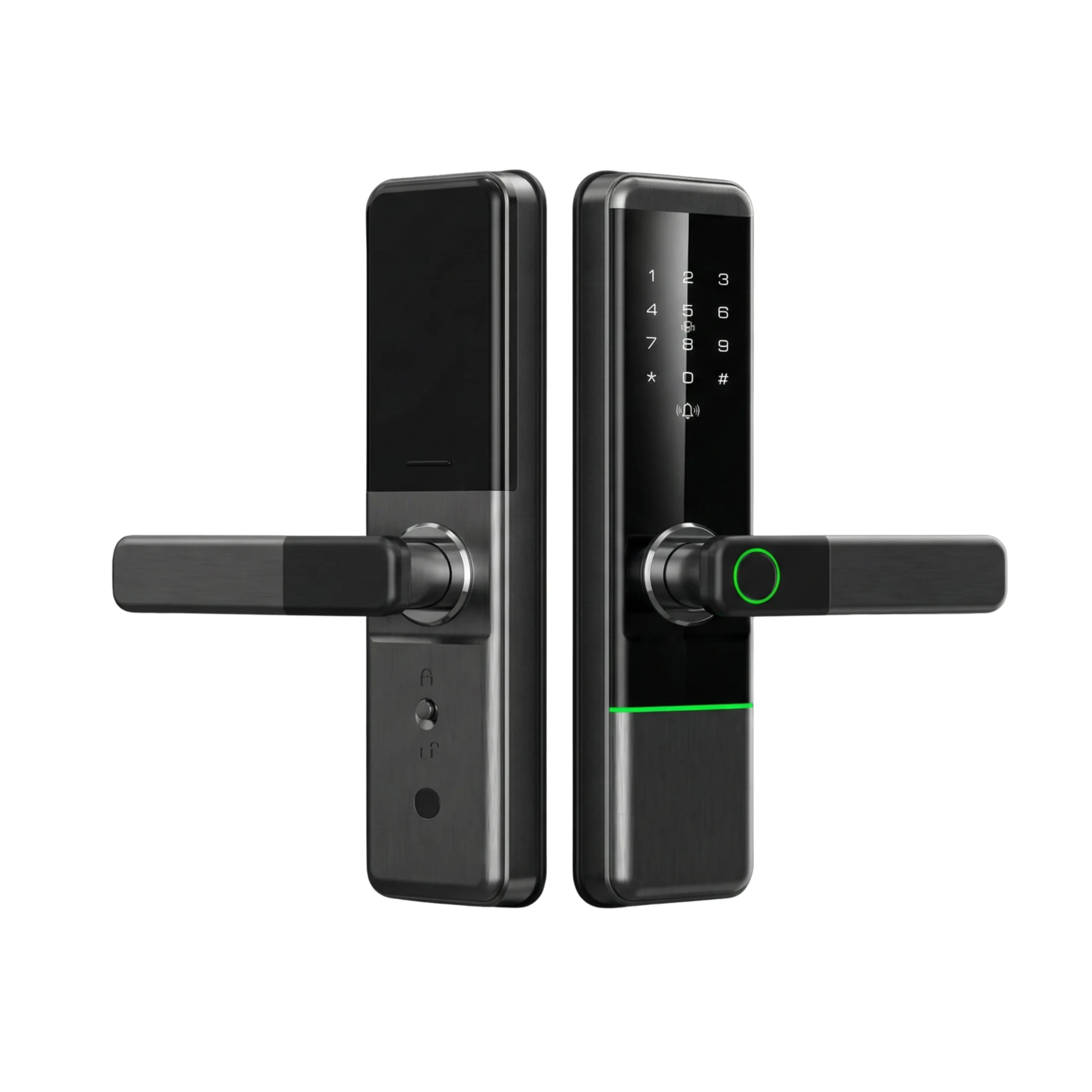
The Altix WeatherShield runs on app, passcode, RFID card and mechanical key, with auto-lock, anti-tamper alerts and a Type-C emergency power port. It has no fingerprint sensor. On a seaward door that matters less than it sounds, because salt film, sunscreen and wet fingers all defeat capacitive sensors, and passcode plus card is the more reliable pairing in that position anyway.
Neither model publishes ASTM B117 salt-spray hours, and neither carries a marine or C5 corrosion certification. We’ve asked our suppliers for salt-spray data along with the operating temperature and humidity ranges, and until those documents are in our hands we won’t quote numbers we can’t show you. What we do instead is specify the fixings, the isolation and the gasket for your real exposure, and tell you honestly which of your doors is going to be the difficult one.
How can Altix help?
Send us a photo of the door on WhatsApp with a rough distance to the water and which way it faces. That’s usually enough for us to tell you whether you’re in the C5 band, which fixings you need, and whether the door needs an IP66 unit at all, because plenty of villa doors sit on the sheltered side and a standard indoor lock is fine there.
We supply, install and service smart locks across Dubai, Abu Dhabi, Sharjah and Ras Al Khaimah, including the coastal communities where this matters most.
Frequently asked questions
Is IP68 better than IP66 for a beach villa?
Not for this problem. IP68 covers continuous immersion in fresh water. It’s a higher sealing standard, but still an ingress test with no salt in it. An IP66 lock with 316 fixings will outlast an IP68 lock with plated steel screws on the same door.
Will a stainless steel lock solve it?
Only if you know the grade. 304 stainless is fine at moderate exposure but pits in crevices under static chloride. 316 contains molybdenum and holds up far better on the frontage. “Stainless” on a spec sheet with no number doesn’t tell you which one you’re getting.
My door is 500 metres from the sea. Do I need to worry?
Less, but not zero. At that distance you’re usually in the moderate band, where salt still arrives on shamal winds. Good fixings and a rinse two or three times a year is normally enough.
Does rinsing the lock with fresh water really help?
Yes, and it’s the cheapest thing on this list. Chloride is water soluble, so a wipe with a damp cloth removes the film driving the corrosion. Monthly on the frontage, quarterly further back. Don’t pressure wash it, and don’t use solvents on the finish. Our smart lock maintenance guide covers the rest of the routine.
Does the warranty cover corrosion?
Usually not. Corrosion in a coastal environment is normally treated as an environmental condition rather than a manufacturing defect, and that’s standard across the industry. Check the specific wording before you buy, and if you’re on the frontage, budget for a replacement rather than assuming a claim.
Can I protect a lock I already have?
Partly. You can swap the fixings for 316, add nylon isolating washers where metals meet, run a silicone bead behind the panel edge and start a rinse routine. What you can’t undo is corrosion that’s already started under the panel, so do it before the first rust weep rather than after.
If you’ve got a door near the water and you’re not sure what it needs, send us a photo and the distance to the sea on WhatsApp. We’ll tell you what to spec, including when the answer is that your door doesn’t need a weatherproof lock at all.


