



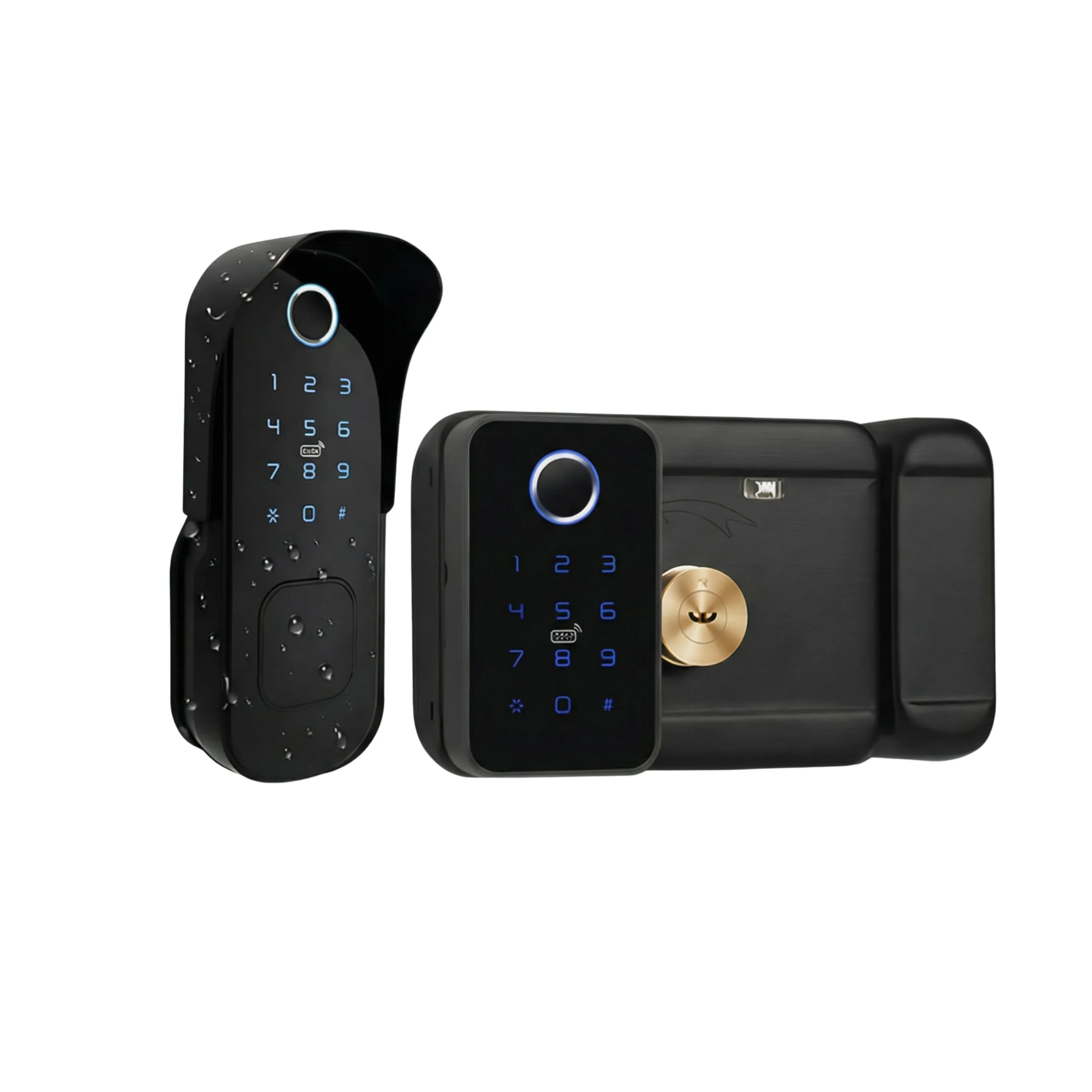
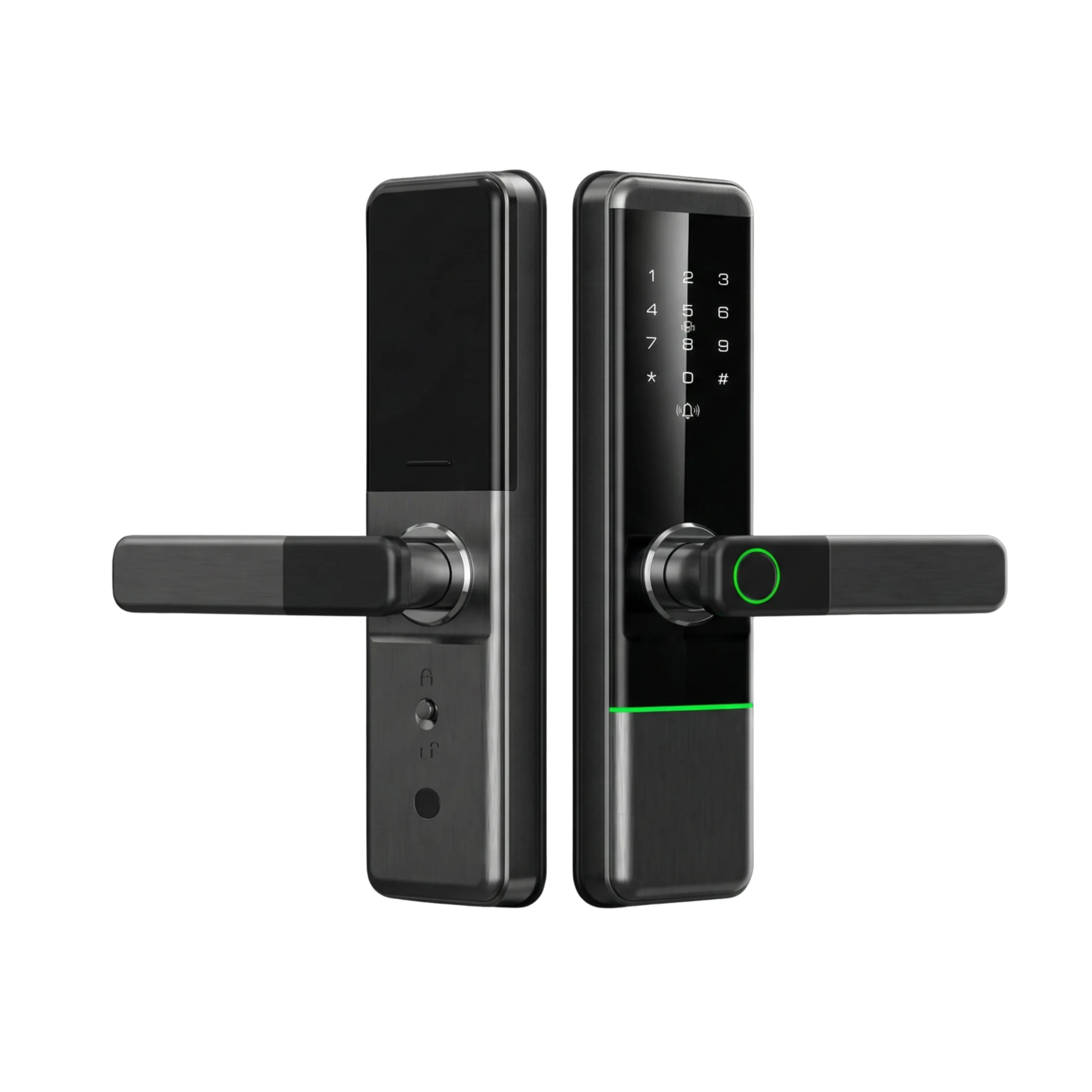









Yes, but not as often as you’d like, and the failures cluster in exactly the moments you’d use the door. Wet hands out of the pool. A finger with sunscreen on it. Six in the morning when the lock face is covered in dew. On an inland villa in Al Barsha a fingerprint reader works nine times out of ten. On a pool gate in Palm Jumeirah in August, we’d tell you not to make it the primary way in.
The lock isn’t at fault here. This is physics, every brand has the same problem, and what separates a good coastal setup from a bad one is which credential you put first. That’s a decision you make before you buy, not after.
We’ve written about what salt air does to the lock’s own metal and about which lock survives on which door material. This one covers the part you touch.
Why does a fingerprint sensor fail when it’s humid?
Because the sensor reads the gap between your ridges and your valleys, and water fills the gap.
A semiconductor sensor, which is what nearly every smart lock in the UAE market uses, works by measuring capacitance across a grid of tiny plates under the surface. Where a ridge touches the surface, capacitance reads one way. Where a valley sits, there’s an air gap and it reads another. The image is built entirely from that contrast.
Water has a dielectric constant around 80. Air is 1. Put a film of water on your finger and the valleys stop being air gaps. The contrast collapses, the sensor sees a smudge, and it either rejects you or times out.
Optical sensors have a related problem for a different reason. They photograph the ridge pattern through a prism, and a water film scatters the light and washes out the image. They also hold onto latent prints on the glass, which in humidity smear rather than dry.
So no mainstream sensor type in a residential lock reads a properly wet finger reliably. Ultrasonic sensors do handle it, because sound passes through a surface water layer, but you’ll almost never see one on a door lock. That’s a phone technology.
Which sensor types handle moisture, and which don’t?
| Sensor type | How it reads | Wet finger | Where you’ll find it | Price band |
|---|---|---|---|---|
| Optical | Photographs the ridge pattern | Poor. Water scatters the light, glass holds latent smears | Older and budget locks | AED 300 to 600 |
| Semiconductor / capacitive | Measures capacitance ridge vs valley | Damp is usually fine, properly wet is not | The default on almost every current UAE lock | AED 500 to 1,200 |
| Ultrasonic | Sound reflection through the skin surface | Good | Phones, not door locks | Not a realistic door option |
| Finger vein | Near-infrared, reads the vein pattern under the skin | Very good, surface moisture barely matters | Rare. The Lockin SV40 at AED 1,599.99 | AED 1,500+ |
Finger vein is the one real answer to the humidity problem, because it reads under the skin rather than on it. Sweat, sunscreen and a damp hand don’t sit between the sensor and what it’s looking at. We’ll say the obvious thing though. The SV40 is an indoor main-door lock, not a weatherproofed outdoor unit. It solves the humidity half of the problem and does nothing about salt. Don’t put it on a pool gate.
What breaks a fingerprint read on a UAE coastal door?
Five things, and they stack.
Wet hands are the most common by a distance. Anyone coming off the beach or out of the pool has water in the ridge valleys and often wrinkled skin from immersion, which changes the ridge geometry itself. Both effects push the match score down at the same time.
Sunscreen and hand cream come next. SPF creams are oil-based films designed to stay on skin. They fill ridges, and they transfer to the sensor face and sit there. The next three people to touch that sensor are reading through somebody else’s SPF 50.
Dawn condensation is the one that surprises people. On the coast, morning relative humidity runs to 90% and above for much of the year, and fog at dawn is normal. On a 30°C night at 85% humidity the dew point sits around 27°C. A metal lock face radiates heat to a clear night sky and drops a degree or two below air temperature, so it crosses the dew point and wets itself. You come out at 6 am to a sensor with a film of water on it that nobody put there.
Salt crust builds up more slowly. Aerosol lands on the lock face, the water evaporates, the salt stays. After a windy week there’s a fine deposit on the sensor that neither you nor the sensor can see clearly. Salt is hygroscopic, so it pulls moisture out of the air and the film re-wets itself on humid nights.
Sand does the permanent damage. Sand plus a dry wipe is how a sensor surface gets scratched, and a scratched sensor coating never recovers.
None of these are hypothetical on a frontage villa. Four of the five happen on the same door on the same day in August.
Do passcode keypads have the same wet-finger problem?
Some of them, yes, and this is the trap almost nobody mentions.
A capacitive touch keypad senses your finger the same way a capacitive fingerprint sensor does. A water film on the panel bridges the touch zones, so the lock either registers a key you didn’t press or registers nothing. If your plan for wet hands is “we’ll just use the code”, check that the keypad isn’t the same technology that just failed you.
Here’s what works with wet hands, ranked from most to least reliable on a coastal door.
- RFID card or fob. It’s a radio exchange at 13.56 MHz between the card and the reader. Water, gloves, sunscreen and salt are all irrelevant, because nothing about your skin enters the transaction. This is the most underrated credential on a beach villa.
- Mechanical key override. Always works, assuming somebody has thought about where the key lives and the cylinder is protected.
- Phone via Bluetooth. Fine in principle. Bad at a pool, because the phone is inside on a table.
- Passcode on a physical or mechanical button keypad. Buttons don’t care about water.
- Passcode on a capacitive touch keypad. Unreliable when wet.
- Fingerprint. Last on a wet-hands door, first on a sheltered one.
This is why we don’t treat the WeatherShield at AED 834.99 having no fingerprint reader as a gap. It runs app, passcode, RFID card and mechanical key. On an exposed door that credential set matches the conditions better than a fingerprint sensor would. A 5-pack of RFID cards is AED 34.99, so a card each for four family members costs less than a taxi to the Marina.
Where fingerprint earns its place is the sheltered main entrance. The RX Ultra at AED 764.99 is IP66 rated and runs fingerprint, PIN, RFID card, mechanical key and phone, which gives you a fingerprint as the daily method and three fallbacks for the days it won’t read.
Which credential should be primary on each door?
| Door | Condition of the hand | Primary credential | Backup |
|---|---|---|---|
| Main entrance under a porch or recess | Dry, shaded, sheltered from spray | Fingerprint | Passcode, card |
| Pool gate | Wet, chlorinated, no phone, no pockets | RFID card or fob on the towel bag | Passcode on physical buttons |
| Beach or terrace door, seaward facing | Wet, sandy, sunscreened | RFID card | App, mechanical key |
| Service or staff entrance | Dry, but many users and turnover | Card or time-limited passcode | App |
| Garage or side door | Dry, usually one or two users | Fingerprint | Card |
The answer changes door to door on the same villa. It follows the state the hand is in when it gets there, which is why buying one lock model for the whole property is how people end up disappointed.
What does a typical day do to a coastal fingerprint sensor?
A villa on the Palm frontage. Family of four. One RX Ultra on the main entrance, one WeatherShield on the pool gate. August.
- 05:50. Overnight air is 31°C at 88% humidity, so the dew point sits near 29°C. Both lock faces have been radiating to a clear sky and are sitting a degree below air temperature. Both are wet with condensation.
- 06:10. The father goes out for a run and touches the main entrance sensor. It fails, because there’s a water film on the sensor face he can’t see in the dark. He wipes it with the back of his hand and it reads on the second attempt.
- 07:30. Sun clears the neighbouring villa. The main door sits in a recess so it stays shaded, and the film evaporates by about eight. From here the fingerprint sensor works normally all day.
- 10:00. Kids go to the pool. Wet hands, no phone, no pockets. The pool gate has no fingerprint reader, so this never becomes a problem. They tap a card that lives clipped to the pool bag.
- 13:00. Everyone reapplies sunscreen. The mother goes back inside through the main door with SPF 50 on her fingers. The read fails, and it leaves a film on the sensor.
- 13:02. The next two people to use that door fail too, because they’re reading through the film. Somebody wipes the sensor with a dry beach towel that has sand in it. That’s the scratch nobody notices until three months later.
- 17:00. Onshore breeze picks up and aerosol lands on the pool gate. It’ll dry into salt by evening and re-wet at 3 am.
- 22:00. Everything works fine. Humidity is high but nobody’s hands are wet, and the day’s failures are already forgotten.
- Next morning, 05:50. Same as step one.
Three fingerprint failures in a day, all explainable, none of them a defect. Specify both doors fingerprint-first and that family logs a dozen failures a week, then concludes smart locks don’t work. Make the pool gate card-first and they log almost none.
Best practices for enrolling fingerprints on a coastal door
Setup does more for read reliability than the choice of brand does.
- Enrol the same finger four or five times, not once. Most locks store 100 prints or more, so use them. Multiple templates of one finger at different angles and pressures is the single biggest improvement available.
- Enrol at least two fingers per person, and pick fingers from different hands. If someone’s carrying shopping, they’ve still got an enrolled finger free.
- Enrol in the condition you’ll use it. If your hands are usually slightly damp when you reach that door, enrol slightly damp. Enrolling a perfectly dry finger in an air-conditioned room and then using it in August humidity is a mismatch.
- Re-enrol after six months on an outdoor door. Skin changes, and a lightly worn sensor reads differently from a new one.
- Clean the sensor with a damp microfibre cloth, then dry it. Never a dry cloth on a sandy sensor, and no alcohol wipes or solvents on the coating.
- Give every household member a card as well, even the ones who never use it. AED 7 a card is cheap insurance against a locked-out teenager.
- Put a real passcode on it too, and make sure it’s one the kids can remember at 10 pm.
What does it cost to set this up properly?
| Item | Cost |
|---|---|
| RX Ultra, fingerprint plus four other methods, IP66 | AED 764.99 |
| WeatherShield, card and code focused, outdoor rated | AED 834.99 |
| RFID cards, 5-pack | AED 34.99 |
| Professional installation, per door, labour | AED 150 to 350 |
| 316 stainless fixings and edge sealing on a coastal install | Under AED 100 in parts |
A two-door coastal setup, main entrance plus pool gate, done properly with cards for the family, lands between AED 1,950 and AED 2,350 including installation on both doors. The alternative is buying one fingerprint lock for AED 600, putting it on the wrong door, and replacing it in eighteen months.
Timeline is short. A survey visit takes under an hour, and both doors get done in the same visit, usually 30 to 60 minutes per door depending on the door material.
Order the coastal setup
-

How can Altix help?
We survey the doors before we quote, and on coastal properties that’s the part that matters. We look at which doors are sheltered and which take spray, which way each one faces, who uses it and what state their hands are in when they get there. Then we recommend a credential strategy per door rather than one lock for the whole villa.
We also say when fingerprint is the wrong answer, which costs us the more expensive lock sale sometimes. It’s cheaper for both of us than a callout in month four.
If you’re on the Palm, in Al Marjan, on Saadiyat, in JBR or anywhere with open water in front of you, message us on WhatsApp with a photo of each door and roughly how far you are from the shoreline. We’ll tell you what to put where before you spend anything.
FAQ
Will my fingerprint lock stop working in humidity?
No. The lock keeps working. What degrades is the read rate on a wet, creamed or salted finger, and every other unlock method on the same lock still works normally.Is a semiconductor sensor better than optical for a coastal door?
Yes, in general. It tolerates a damp finger better and it doesn’t hold latent smears on a glass platen the way optical does. Neither one reads a properly wet finger.Does an IP66 rating mean the fingerprint sensor is waterproof?
It means the enclosure resists dust and powerful water jets. It says nothing about how well the sensor reads through a water film, and nothing at all about salt corrosion. We’ve covered that difference in our IP66 and salt piece.Why does my lock fail in the morning but work fine in the afternoon?
Almost always condensation. The lock face cools below the dew point overnight and wets itself, then reads normally once the sun burns the film off. An outdoor sensor that fails at dawn and works by nine has this and nothing else.Can I use a smart lock on a pool gate at all?
Yes, and you should, because it’s usually the least secure opening on a beach villa. Just don’t specify fingerprint as the way in. Card, fob or a code on physical buttons.Do face recognition locks solve the wet-hands problem?
They sidestep it, since your face isn’t wet the way your hands are. Their own failure modes are strong backlight on a west-facing door and sunglasses. On a shaded entrance they’re a reasonable answer. On a sun-blasted seaward door, less so.How often should I clean an outdoor fingerprint sensor?
Weekly on a frontage villa, monthly further inland. Damp microfibre, then dry. It takes ten seconds and it’s the difference between a sensor that reads first time and one the family stops trusting.Does salt damage the sensor itself or just block it?
Both, over time. In the short term it’s a film that blocks the read. Over months, salt plus moisture at the seam around the sensor bezel becomes a corrosion path into the housing, which is a different and more expensive problem. Our salt corrosion guide covers what to look for.Still not sure which method belongs on which door? Send us a WhatsApp and we’ll go through it door by door.
Popular Post
View All Security & Safety
Are Smart Locks Secure? Myths vs. Reality (Expert Breakdown)
Are smart locks secure for real homes and properties in Dubai and Abu Dhabi?For most households, rentals, and…
Read More Info → Apartments & Villas
How to control Smart Locks with Alexa, Google Home
Smart locks aren’t just about replacing keys, they’re about convenience. One of the biggest advantages of choosing the…
Read More Info → How-to
Tuya vs TTLock – Which App is best?
Tuya vs. TTLock: Which Smart Lock Platform Should You Choose for Your Home? Smart locks are becoming more…
Read More Info →
Smart Locks in UAE: The 2026 Buyer’s Guide You Actually Need
If you’re upgrading security in your home, villa, or office in the UAE, the smartest move in 2026…
Read More Info →Wi-Fi, Remote & Smart HomeBluetooth vs Wi-Fi Locks – Which One Fits Your Space?
Should your smart lock work only when you are standing at the door, or should it let you…
Read More Info →
Sliding Door Smart Locks in the UAE: Balcony, Patio and Glass Sliders
Most smart locks are built for swing doors and won't fit a slider. See what works on UAE…
Read More Info →


