


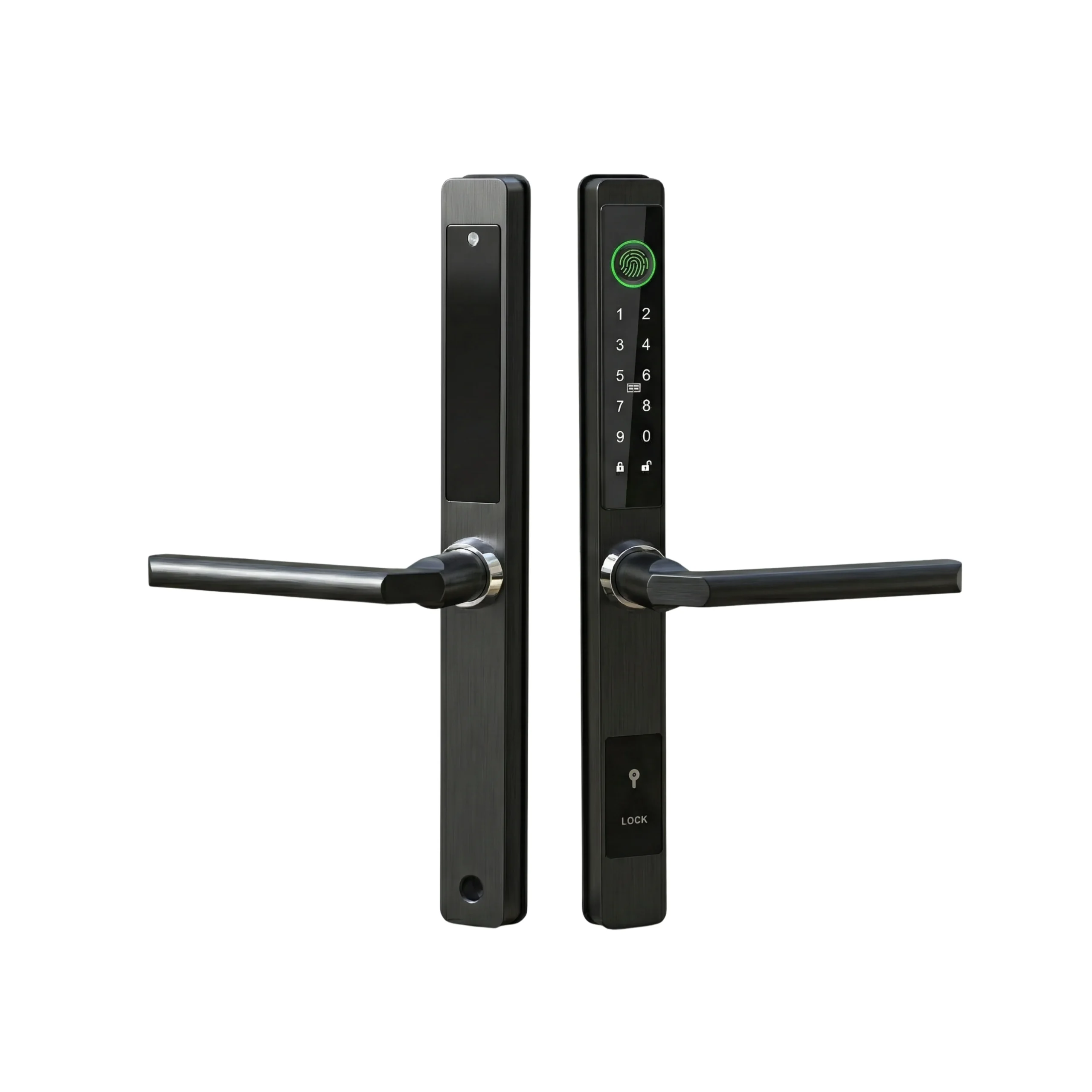

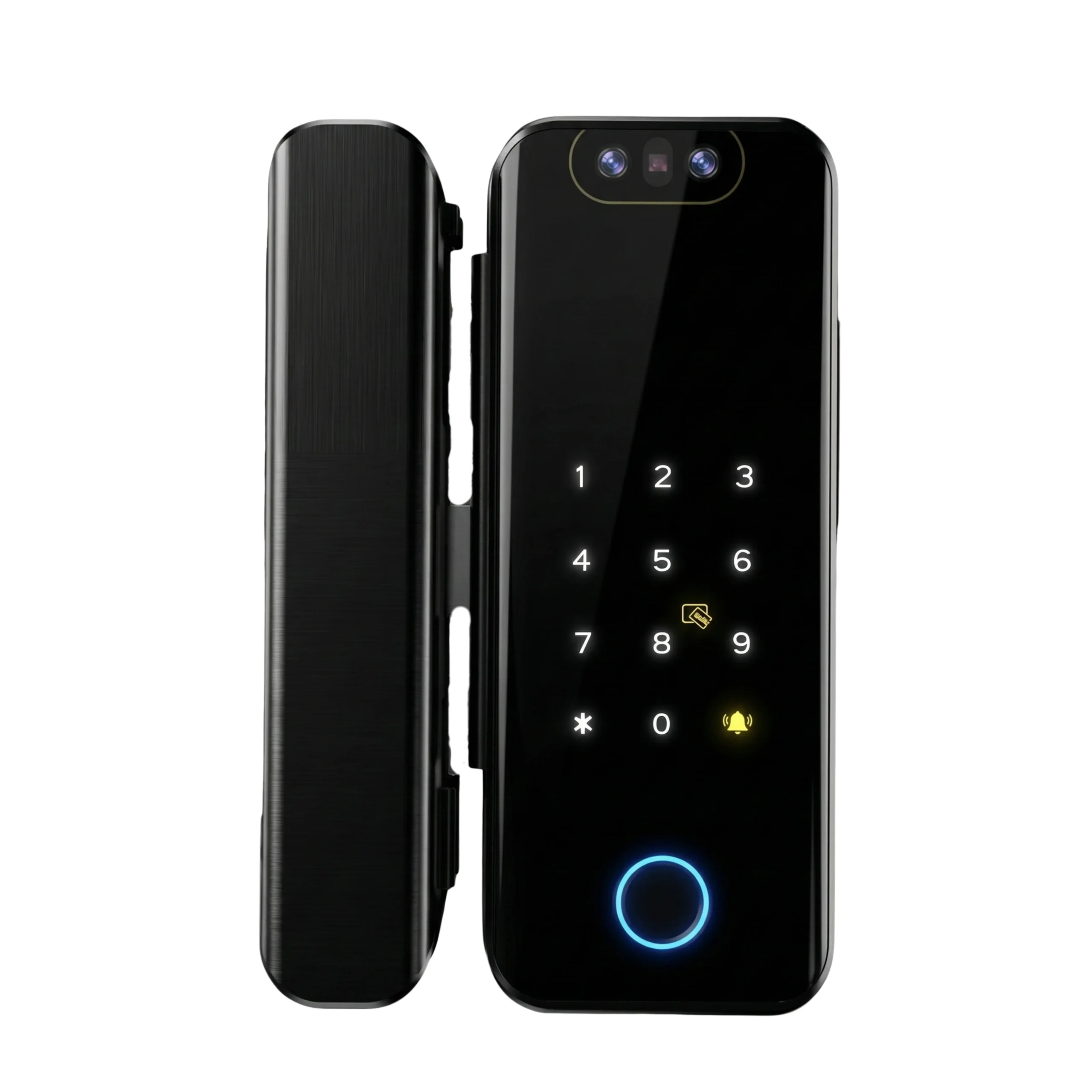









For most UAE homes, a fingerprint lock is still the right buy. Vein recognition earns its extra AED 800 to AED 1,900 on two doors specifically: one where fingerprints keep failing, and one where somebody in the house can’t line a fingertip up the same way twice. Face recognition sits between the two and it’s the quickest of the three when your hands are full.
That’s the short answer. The longer one matters because these three read completely different things, and they break in completely different ways. Buy the wrong one and you get a door that works for four people in the house and not for the fifth.
We stock all three. Below is which one goes where, including the cases where the cheap one is the correct answer.
What does each biometric read?
Fingerprint sensors read the outside of your skin. Optical sensors photograph the ridge pattern on your fingertip. Capacitive sensors measure the electrical difference between a ridge touching the surface and a valley sitting a fraction of a millimetre away. Either way the sensor is looking at the surface, so anything sitting on that surface gets read too. Water, sun cream, flour, plaster dust, a plaster.
Vein sensors read underneath your skin. They shine near-infrared light into the finger or the palm. Haemoglobin in the blood absorbs near-infrared far more strongly than the tissue around it, in roughly the 700 to 900 nanometre band, so the veins come out as dark lines against lighter tissue and the sensor maps that pattern.
Two things follow from that. Surface conditions stop mattering, because the sensor isn’t looking at the surface. And blood has to be moving for the pattern to exist at all, so you get liveness checking as a by-product rather than as a feature somebody bolted on afterwards.
Face recognition covers two very different technologies sold under one name. A 2D system reads a flat image from an ordinary camera. A 3D structured-light system projects tens of thousands of infrared dots onto your face and works out depth from how those dots distort across the contours. Lockin quotes around 30,000 dots on the V5 Max. Depth is the reason a printed photo won’t open a 3D lock and will sometimes open a cheap 2D one.
| Fingerprint | Finger vein / palm vein | 2D face | 3D face | |
|---|---|---|---|---|
| What it reads | Ridge pattern on the skin surface | Vein pattern under the skin | Flat image of your face | Depth map plus infrared image |
| Contact needed | Yes | Finger vein yes, palm vein no | No | No |
| Liveness built in | Only on better sensors | Yes, needs blood flow | No | Yes, from depth and skin material |
| Works in the dark | Yes | Yes | Poorly | Yes, infrared |
| Copied from | A lifted print, a mould | No practical field method | A photo or a video on a phone | Not from a photo |
| Typical read time | Under 1 second | Makers quote 0.17 to 1 second | Under 1 second | Under 1 second |
One honest note on that table. The 0.17 second figure is Lockin’s own number for Venokey on the Veno Plus, and the 99.9% accuracy claim on the same page is theirs too. Nobody in this market has put these locks through an independent lab, us included. Treat manufacturer biometric figures as a direction of travel and nothing firmer.
Where does each one fail?
This is the part that decides your purchase, and it’s the part most UAE lock listings skip.
Fingerprint
Wet hands are the everyday problem. Water bridges the gap between ridge and valley and the sensor loses the contrast it needs.
Worn ridges are the serious problem. Construction, cleaning, gardening, cooking and age all flatten ridge detail. One study of fingerprint authentication on mobile devices found an equal error rate of 30 to 36 percent for older users, against roughly 96 percent accuracy for everyone else. That’s a single study on phone sensors rather than door locks, so don’t take the exact numbers to the bank, but the direction matches what we see on site. When a customer tells us their father in his seventies has to try four times every morning, we stop recommending fingerprint.
Dry skin is the UAE-specific one. Air conditioning running eight months a year dries hands out, and dry skin makes poor contact.
Henna comes up every Eid and wedding season. Wet paste on a fingertip blocks an optical sensor outright. A dried stain is far thinner and usually reads fine, though we’ve seen enough borderline cases that we tell customers to enrol a finger they don’t decorate as a second credential.
Sun cream, salt and pool water get their own treatment in our post on fingerprint sensors in coastal humidity.
Vein
Cold reduces blood flow near the surface and weakens the contrast. In the UAE that’s rare, though a hand coming straight off the steering wheel of a car that’s been running its air conditioning hard can read slowly for a few seconds.
Positioning is where most people struggle. A palm vein reader wants your hand at roughly the same distance and angle every time. Most people have it inside a week. Some never do, and for those people a passcode becomes the daily credential and the palm becomes the backup.
Direct sunlight into the sensor is the failure mode that catches people out. These readers work in infrared and midday sun is full of infrared. A west-facing door in Dubai between two and five in the afternoon is the hard case. A porch, a recess or a 300mm overhang solves it.
Face
NIST’s testing on partially covered faces found accuracy falls when the face is obscured, and falls further the more of the nose is covered. False rejections go up. Their study used digitally applied masks rather than real ones, so read it as an indication rather than a field measurement. In UAE terms it means a lock enrolled on an uncovered face won’t reliably recognise the same person in a niqab. A household where that matters should enrol both states, or give that person a different credential.
Height catches people out too. A camera aimed at a 170cm adult will fight with a six-year-old and with anyone using a wheelchair. Check the reach before you buy.
Backlight kills 2D face locks. Stand in front of a glass villa door with the afternoon sun behind you and the camera sees a silhouette. 3D infrared systems handle this far better, because they aren’t relying on visible light.
| Condition | Fingerprint | Finger vein | Palm vein | 3D face |
|---|---|---|---|---|
| Wet hands | Fails often | Works | Works | Works |
| Worn or aged ridges | Fails often | Works | Works | Works |
| Hand cream or sun cream | Fails often | Works | Works | Works |
| Both hands full of shopping | Fails, you need a free finger | Fails | Works | Works |
| Face covered | Works | Works | Works | Fails or degrades |
| Afternoon sun on the reader | Works | Degrades | Degrades | Degrades on 2D, holds on 3D |
| Child or wheelchair user | Works | Works | Works | Needs a height check |
| Total darkness | Works | Works | Works | Works |
Which biometric fits which door?
| Door and household | Buy | Why | Model to start from |
|---|---|---|---|
| Villa main entrance, family of four or more | Palm vein, or palm vein plus face | You arrive with shopping, a child and a phone | Altix Prime, Lockin V5 Max |
| Apartment front door, one or two adults | Fingerprint | Office hands give clean reads for years | Altix RX Ultra |
| A door with an older parent behind it | Vein | Worn ridges are a surface problem and vein ignores the surface | Lockin SV40, Lockin S5 |
| Office or staff entrance | Face | Hands-free at speed, and nobody wants to touch a shared sensor forty times a day | Altix Smart Attendance lock |
| Trades, kitchens, salons, workshops | Vein | Ridge detail on those hands is gone by year three | Lockin S6 Max |
| Shared housing under the new Dubai permit | Passcodes and cards, biometrics only on owner-controlled doors | Turnover is the enemy of enrolled biometrics | See the shared housing checklist |
| Outdoor gate, pool gate, beachfront | Not face, and be careful with vein | Sun into the reader, plus salt and rain as separate problems | Read the beachfront door guide first |
Two of those rows deserve more than a line.
The villa entrance is where palm vein pays for itself, because it’s the only credential in the list that works when both your hands are full. The Lockin V5 Max at AED 2,659.99 pairs palm vein with 3D face. The Altix Prime at AED 2,299.99 pairs palm vein with 3D face and fingerprint on an all-steel 6068 mortise.
The apartment door is where people overspend. Two working adults will get years of clean reads out of an RX Ultra at AED 764.99, and spending AED 1,900 more here buys very little. If you rent, read our guide on smart locks in a rented Dubai apartment before you order anything at all.
A worked example: fitting a palm vein lock on a five-person villa in Al Furjan
Real sequence, real times, from a job we run most weeks. The household is two working parents, a nine-year-old, a grandmother in her late seventies, and a housekeeper who comes Tuesdays.
- Site check, 20 minutes. We measure the door leaf thickness and the existing mortise cut-out. The V5 Max and the Prime both take a 6068 mortise. If the door already has one, fitting is quick. If it doesn’t, the leaf gets cut.
- Check the sun, 5 minutes. We stand at the door at the time of day the family gets home. If the reader will take direct sun, we say so before anything goes on the door.
- Fit, 90 minutes to 2 hours. Longer on aluminium than on timber, because aluminium needs different fixings and a slower cut.
- Create the admin account first, 5 minutes. One person owns it. Not a shared login, and not the installer’s phone. Everything else hangs off this account.
- Enrol the grandmother first, 10 minutes. She goes first on purpose. If the mounting height or the reader angle is wrong for her, we find out while the drill is still on the floor. Three captures of one palm, then a fourth of the other hand.
- Test hers ten times cold, 5 minutes. She walks away, comes back, opens it. Ten times. A failure now costs nothing, and a failure in week three costs a callout.
- Enrol the two parents, 10 minutes. Both hands each.
- Enrol the nine-year-old, 10 minutes. Check he reaches the reader standing flat, not on tiptoe. If he can’t, he gets a passcode until he grows.
- Housekeeper gets a passcode, not a palm, 5 minutes. Recurring, Tuesday 08:00 to 13:00. When she leaves the job you delete a code, and you never have to explain to anyone why you’re deleting their biometric.
- Set the backup path, 5 minutes. Everyone learns where the mechanical key lives. One spare goes off site, with a neighbour or in the car. The Prime runs a 4,200 mAh battery and Altix quotes six to eight months, so plan a charge twice a year.
- Read the log at day seven, 2 minutes. Open the app and look at the failed attempts. If one person is failing repeatedly, re-enrol them then, rather than letting it turn into the family complaint six weeks later.
Total on-site time is about three hours, and step 5 is the one that saves you money.
What does it cost in the UAE?
Prices below come from our own shop, in AED including VAT, checked the day this went up. They move, so click through before you build a budget on them.
| Lock | Biometric | Price (AED) |
|---|---|---|
| SwitchBot Keypad Vision | 3D face, retrofits onto an existing SwitchBot lock | 429.99 |
| Altix RX Ultra | Fingerprint | 764.99 |
| Solity GP-6000BAK | Face and fingerprint, Korea made | 1,059.99 |
| EZVIZ DL50FVS | Dual-lens 3D face | 1,299.00 |
| Altix Smart Attendance lock | Face and fingerprint, with attendance logging | 1,299.99 |
| Lockin SV40 | Finger vein | 1,599.99 |
| Lockin S5 | Finger vein | 1,649.99 |
| Lockin Veno Plus | Palm vein, with video | 1,719.99 |
| Lockin S6 Max | Finger vein plus 3D face, dual camera | 1,999.99 |
| Altix Prime | 3D face, palm vein and fingerprint | 2,299.99 |
| Lockin V5 Max | Palm vein plus 3D face | 2,659.99 |
The number that matters is the gap. Moving from a fingerprint lock at AED 764.99 to finger vein at AED 1,599.99 costs you AED 835. Moving to palm vein at AED 1,719.99 costs AED 955. Going all the way to the V5 Max is AED 1,895 more than the fingerprint lock.
Installation sits on top of that. Budget AED 150 to AED 350 for a straight swap where the mortise already matches, and more where the door needs cutting. A fire-rated steel door or a frameless glass door is a different conversation and we’ll quote it once we’ve seen photographs of the door edge.
When is vein not worth the money?
Five cases where we’d tell you to keep the AED 900:
- Two office workers in a one-bedroom apartment. Your fingerprints are fine. Buy a good fingerprint lock and put the difference into a gateway and a decent doorbell.
- A rental you’ll leave in eighteen months. You’re paying a premium for a sensor you’ll take off the door before it has earned anything back.
- Any door where a passcode is doing the real work. Holiday homes, short-let units and staff doors run on codes, and the biometric is decoration.
- A door in full west-facing afternoon sun with no shade. Fix the shade or pick a different credential rather than buying a vein lock and hoping.
- Anywhere with more than about eight people cycling through per year, because enrolment and deletion overhead eats the benefit.
Vein makes sense when a specific person in the household keeps failing on a fingerprint sensor and you already know who that person is. If you can’t name them, buy the cheaper lock.
Where does your biometric data go?
Under Federal Decree-Law No. 45 of 2021, the UAE’s Personal Data Protection Law, biometric data counts as sensitive personal data, and processing it carries stricter conditions than ordinary personal data, including explicit consent in most cases.
For a family home this is mostly common sense. Ask before you enrol somebody, and delete the template when they move out.
For an office it’s a real obligation. If you’re enrolling staff faces or fingerprints for attendance, you need their consent, you need to be able to explain what you’re storing and where, and you need to delete it when they leave. Write the HR policy before the lock goes on the wall.
On the hardware side, ask one question of any supplier, including us. Does the biometric template stay in the lock, or does it go to a server? On the locks listed above the template is held on the device, and the app carries account and access data rather than your vein map. Ask for that in writing anyway, and treat a vague answer as an answer.
FAQ
Is palm vein more secure than fingerprint?
For copying, yes, and not by a small margin. Fingerprints get left on every surface you touch, and they’ve been reproduced from lifted prints and moulds. Vein patterns sit under the skin, aren’t left behind, and need blood flow to read at all. For everyday false-accept risk in a home, both beat a four-digit code you’ve written on the back of a delivery slip.
Can a photo open a face recognition lock?
On a 2D lock, sometimes. On a 3D structured-light lock, no, because the system is measuring depth and skin surface rather than matching a flat picture. If a face lock listing doesn’t say 3D or structured light anywhere, assume it’s 2D.
Does finger vein work if my hands are wet?
Yes, and that’s the main reason to buy it. The sensor reads under the skin, so surface water changes very little.
My father’s fingerprint never works. Will vein fix it?
In our experience, usually. Worn ridges are a surface problem and vein sensors don’t read the surface. We’d still test-enrol him before you commit, and any decent supplier should let you.
Do these locks work in a power cut?
They run on their own battery, so a building power cut doesn’t stop them. The Altix Prime holds 4,200 mAh and Altix quotes six to eight months per charge. Every model listed here also takes a mechanical key and emergency USB-C power.
Can I have vein for me and a passcode for the housekeeper?
Yes, and you should. Mix credentials by role. Biometrics for permanent residents, timed passcodes for anyone temporary, cards for anyone who won’t use an app.
Is face recognition a problem if someone in the house wears a niqab?
It can be. Recognition accuracy falls when the face is partly covered. Enrol the covered state as well, or give that person palm vein or a passcode as their main credential. Treat it as a fitting decision to be handled at enrolment.
Which one is fastest?
All three open in about a second in normal conditions. Judge them on how often they fail rather than on speed. Face and palm vein win when your hands are full, because you don’t have to put anything down first.
Buy the biometric that fits the door
-
Lockin Veno Plus Palm Vein Recognition Video Smart Lock
- Palm vein
- Fingerprint
- Passcode
- Card
Only 2 left
Sale!-12% NewAltix Prime Smart Lock – 3D Face Recognition, Palm Vein & Fingerprint Door Lock with WiFi & TTLock App
- Face recognition
- Palm vein
- Fingerprint
- Passcode
Only 4 left
How can Altix help?
Tell us who lives behind the door and we’ll tell you which sensor to buy.
If there’s someone in the house whose fingerprints keep failing, say so and we’ll narrow it to two models. Send a photo of the door edge and the existing lock and we’ll confirm the mortise before you order. If a fingerprint lock is the right answer for your door, we’ll say that too, even though it’s the cheaper sale.
Message us on WhatsApp with a photo of your door and how many people use it. We’ll come back with a shortlist and an installed price.
Popular Post
View All Security & Safety
Are Smart Locks Secure? Myths vs. Reality (Expert Breakdown)
Are smart locks secure for real homes and properties in Dubai and Abu Dhabi?For most households, rentals, and…
Read More Info → Apartments & Villas
How to control Smart Locks with Alexa, Google Home
Smart locks aren’t just about replacing keys, they’re about convenience. One of the biggest advantages of choosing the…
Read More Info → How-to
Tuya vs TTLock – Which App is best?
Tuya vs. TTLock: Which Smart Lock Platform Should You Choose for Your Home? Smart locks are becoming more…
Read More Info →
White Friday Smart Lock Deals in the UAE: How to Tell a Real Discount From a Fake One
Buying a smart lock on White Friday or National Day in the UAE? How to spot an inflated…
Read More Info →
Smart Locks in UAE: The 2026 Buyer’s Guide You Actually Need
If you’re upgrading security in your home, villa, or office in the UAE, the smartest move in 2026…
Read More Info →Wi-Fi, Remote & Smart HomeBluetooth vs Wi-Fi Locks – Which One Fits Your Space?
Should your smart lock work only when you are standing at the door, or should it let you…
Read More Info →


